
ENTRANCE

Look back
Till you see
What’s in the dark

Look back
The spotlights
Catch their eyes

Look back
As they stretch
To see you

Look back
Then turn away
From the void
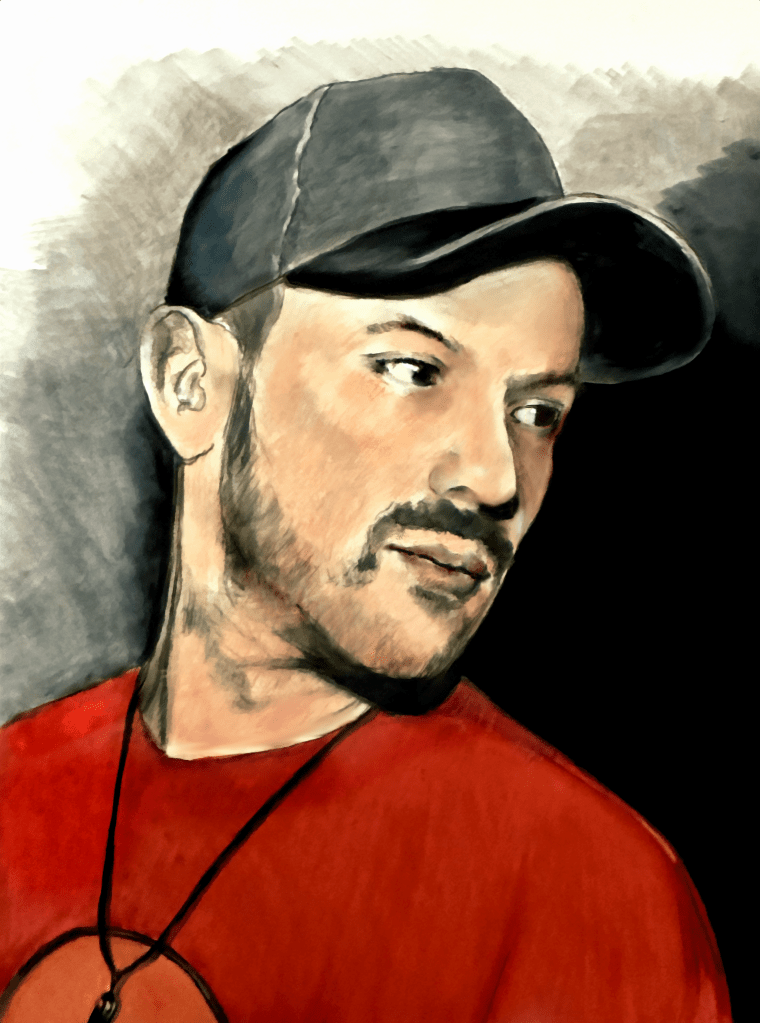
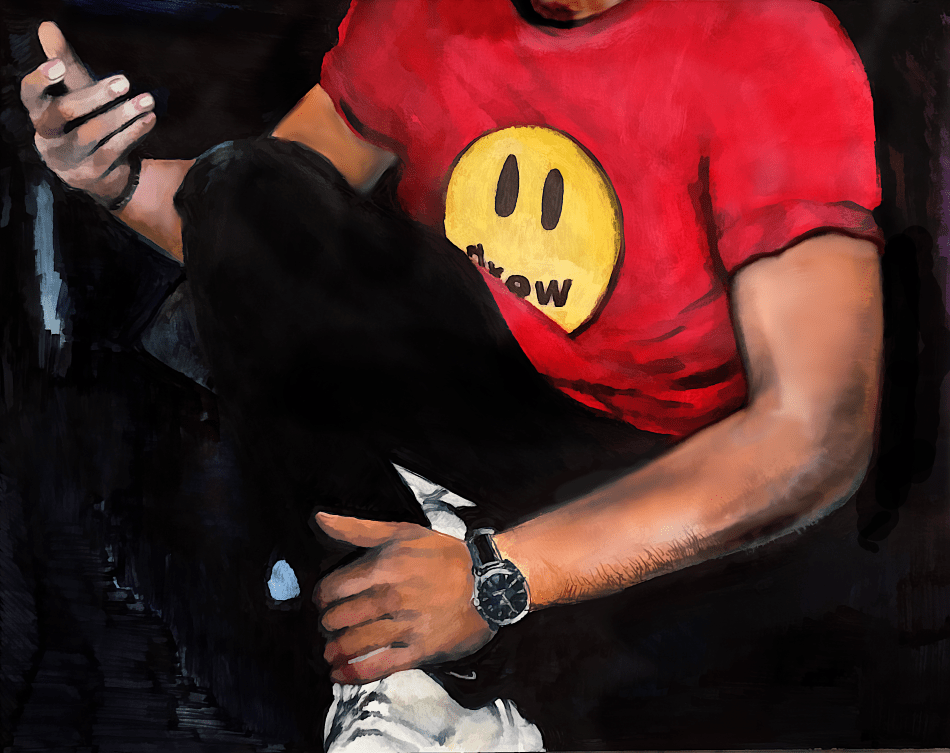
“Entrance” and “DJ on the Floor”
DJ ON THE FLOOR

You enter the room
Close behind the bouncer
Who clears the way as
The people press closer
You sidestep their grasps
You’re as calm as a neutron
In control of the dancers
Since it’s your floor they’re on
“Entrance” (#2) and “DJ on the Floor” (#3) images and poems from: Soul Collective – Poems and Paintings, by Marthe Bijman, pp. 5-6. (July 2025, 2nd Ed., Blurb Books, ISBN 979-8-31-996715-2). Paintings: Mixed media, acrylic, ink pen, on board.
About Soul Collective
Each poem has a (back) story
“Entrance” and “DJ on the Floor” are about being a DJ in a nightclub. In both poems, each line is sentence case, without punctuation, because that’s how you present lyrics.
In lyrics, the most important things are the syllables, phonemes, rhymes, and number of lines. You don’t show punctuation in the written lyrics because you don’t need it. Also, inflection, intonation, and timing are not indicated by punctuation, but by the meaning of the lyrics, and by all the elements inherent in the composition. How you interpret these, will make whatever punctuation you had in the lyrics originally, obsolete. So don’t bother.
So you think you know what a DJ does? Why should you care?
When I found out exactly what it is that DJs do, and how they feature in clubs, I got the impression of someone who walks past hungry animals lurking off the path in a pitch-black jungle. (I had a general idea of course, but not the specifics.) I tried to show this implied threat in the painting and the poem.
I think “DJ” (disc jockey) is the wrongest title, since a DJ is, more often than not, also a music producer, an artist. But it’s historical, and it stuck. The DJ plays the music, and controls the music playlist, and controls the people – the guests, drinkers and dancers – in the club. The objective of the club owner or promotor is to keep people dancing, to keep them happy, to keep them coming to the club, to keep them spending money. (Ta-dah.)
The objective of the DJ is to keep the clubbers on the dance floor, by observing how people react to different tracks. If a track doesn’t grab them, they’ll get distracted and move along, stop dancing, or leave the club. They will be instantly bored. Boredom is a killer in a club, and all it takes is one song. The DJ’s job is to prevent this. While he – yes, he, there are comparatively few women DJs in the industry – can perhaps only see spotlights and high beams on the floor of the venue, usually darkened since it’s some unholy hour of the night when ordinary people are sleeping, he has to very carefully observe the clubbers. I’m told what they do is pick one or two noticeable people, or types, and focus on them.
Who’s looking at who?
But, while what he sees on the dance floor may be hard to make out, he knows that literally hundreds of eyes are on him, up there, lit up like a Christmas tree by the lights of his deck, and only on him. The number of people who attend the most famous clubs varies greatly, but large clubs can hold thousands, with capacities reaching 10,000 for super-clubs. The world’s largest nightclub, UNVRS in Ibiza, has a capacity of 10,000 people. Apparently, in cities with a buzzing nightlife, like Melbourne, average attendance in the local clubs is around 600 people per night. All these people, dancing like crazy at one or two in the morning…what do they do when the sun comes up? Turn back into vampires?
The eyes of the mass of people, when the DJ enters the venue and walks up to the booth, are like the eyes of wild animals gleaming in moonlight. But, in reality, the DJ is not a prospective meal, but a puppeteer. The dancers are under his control – if he is a pro. He must know how to deal with this situation.
Let’s get technical
What does a DJ do exactly – and how? I had no idea, until my co-writer educated me. He is also a DJ, and a famous one at that. What happens live, in the club or on stage, is that he merges the tracks that he plays, to form an uninterrupted, and musically cohesive, stream of sound. Uninterrupted. No breaks. No distractions. A stream of sound in one genre.
This means that, for example, if tracks that follow each other have different beats per minute (BPMs), he has to slow down or speed up the preceding track, and segue in the next track, without a break. And, if the consecutive tracks are in different keys, he may transpose the closing bars of the finishing track up or down, to fit, or the other way around, like a temporary bridge. To blend the rhythms, let’s say of a track that’s 4/4 time with the next one that’s 6/8, he might cut in a few bars of a different track that is neither, to smooth the switchover. Since all tracks, all songs, are, per definition, unique creations, it means that this is the default scenario.
It’s like creating a series of intermezzos or interludes that tie all the tracks together by the millisecond – on the fly! The DJ does all of that, live. (Let me emphasize this: the songs on the set list are comped and synched to milliseconds.) No re-dos, no fixes, no dead air. To get it right takes a lifetime’s experience, the memory of an elephant, thorough preparation, and an absolute devotion to music and particular genres.
If you think “DJ” and you visualize the solo guy who plays songs at a wedding reception, or in a pub, falling back on ABBA, one-hit wonders, film scores, and the requests of the guests, think again. For one, professional DJs do not do requests. It screws up the playlist.
The numbers are staggering
These days, if a House or Dance track is about 2 min. 30 sec. long, as an industry average, and a set (or session) is 2 hours, a session can consist of about 60 (sixty!) tracks, lined up, back to back. Even me, with my dyslexic Maths, can appreciate this number. And, since the DJ cannot predict the reaction of the clubbers, he has to have, in his head, even more songs than those all lined up, to switch to. He has to know every song and how it could fit, and he has to have the rights to play it. In terms of memory capacity, your high-end DJ walks around with 300 – 400 tracks in his head at any given time. And at the club, they have to be accessible on his storage devices. Imagine the terabytes.
Next time you’re on Spotify listening to a radio playlist by a specific DJ, remember this: Some of the tracks on the playlist will be the releases of the specific publisher, others will be the previously released or forthcoming tracks produced by the DJ whose name is on the playlist. The DJ says; I’m so and so and this is my mix. This mix is a fraction of the mix in his head. The online playlist of, let’s say, 20 tracks, is a curation, very tricky to put together and squeeze into the allotted playtime, especially when the DJ takes into account how the track was received when he, or other DJs, debuted it in a club.
But, why?
The DJ’s set list exposes the people in the club to intensive repeats of tracks, making them go beyond just hearing a song, to moving to the song, to actually listening to the song, to wanting to hear it again. And it gives the producer a chance to road-test a track to see how it affects people. It’s merciless, in a way. Your track has just a few seconds, a couple of bars, to grab someone’s ears and pull them in. (As I learned; “don’t bore us, get to the chorus, asap”.)
What does the person in the club get out of it? They hear new music for free; they can dance to tracks in their favourite genre; they get serotonin, endorphin, and dopamine zaps over and over from the hooks and the beats.
And while the dancers are grooving to the music, the DJ is also dancing and whipping them into a frenzy. And you’d think that the DJ is as out of his mind as they are…But, nope. DJs may look like they are, but the wheels and cogs in their precise, clinical, critical brains are wa-a-a-a-ay ahead of you – three or four tracks into the future – and observing and manipulating you while as stone cold sober as a judge. Yep. Being high while you do this job is not recommended. You’ll screw it up royally.
If someone says to you, ‘I want to be a DJ; I want a permanent gig in that club‘, you’d better hope that person knows how it all works. I, for one, could never be a DJ – I haven’t got good enough hearing or a good enough memory. Don’t know enough about music, or enough music. Besides, being in crowds of people freaks me out. And I can’t stand loud sounds. Welp, those are the breaks. No pun intended.
From your lyrics to their ears
Now, imagine you’re an artist, a songwriter, a lyricist, a poet in your heart of hearts. Imagine that you wrote lyrics that mean a lot to you and that you think will mean something to others. Imagine that your lyrics made it onto a House music track. Now imagine those words, on that track, hitting the ears of hundreds and hundreds of people, night after night, in a club. Your words, now repeated by and hummed by all those people, because the DJ included it in his set. How’s that for power? Feeling better about your verses and choruses now? You probably want to be quite certain that you said what you mean and meant what you said, just in case, by some miracle, your song reaches this elevated status. Because your sentiment will be cemented.
So, there you are. This is what the poem is all about, and in fact, what every song that my writing partner and I produce, is all about. That’s why he’s got this look on his face, in the first painting. He knows what’s coming.
 SEVEN CIRCUMSTANCES
Absoluut fassinerend – en daardie portret is briljant.
Dankie, Fran!🙏