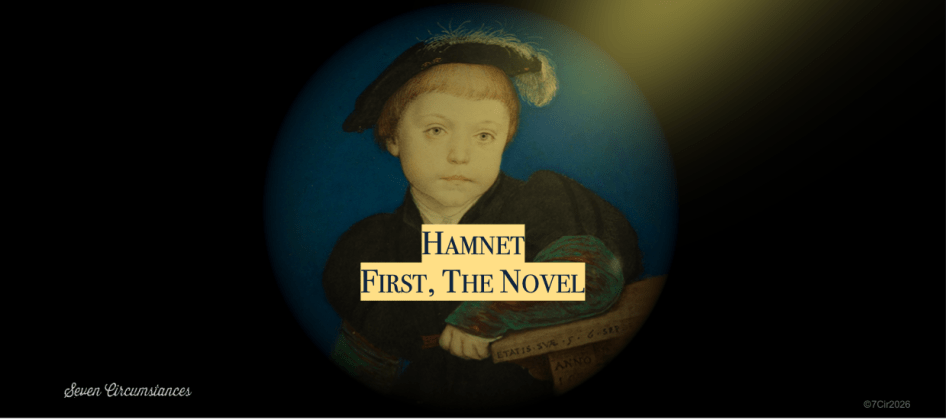
On Jan. 11, 2026, “Hamnet”, directed by Chloé Zhao, won Best Motion Picture – Drama, and Best Actress in a Motion Picture – Drama (for Jessie Buckley) at the 83rd Golden Globe Awards. Zhao co-wrote the screenplay with Maggie O’Farrell, on whose novel, “Hamnet and Judith”, the film is based. So while the film is hot news and you might want to view it to see what all the praise it has received is about, But I suggest, if you haven’t done so already, first read the novel.
If you ask ‘why?’, here is my review of the novel, published in 2020, which is one of the most beautifully written books I’ve ever read.
The novel: “Hamnet and Judith”
Hamnet and Judith – A Novel, by Maggie O’Farrell (Paperback; publisher: Knopf Canada; date of publication: July 21, 2020; 384 pages) It is on the long list for the Goodreads Choice Award 2020 for Historical Fiction.
For the first time in a very long while, I could feel tears coming to my eyes while I was reading a novel. I do not often cry when I read books because I am conscious of the techniques and writing styles being used by an author. But this caught me by surprise. I stopped, read the passages again, and sniffled some more. Why did Hamnet and Judithby Maggie O’Farrell move me so? It is very beautiful. It is the best thing I’ve read in a long time.
Maggie O’Farrell’s writing is so simple, understated and direct that each sentence carries the same weight as many pages would in other novels. She describes the crucial moments in the story as if she had personally lived it, and observed exactly what she saw, smelled, felt, and thought, and then wrote it down so that you can experience it as if you were there. She has the ability to depict characters and their relationships in such a way that you feel deeply empathetical towards them. You feel as if you are them. It is a quite an experience.
It is, to quote one reviewer, “blisteringly beautiful”. Another wrote it is “a thing of shimmering wonder”. I absolutely agree.
Until now I had never read anything written by Maggie O’Farrell. I bought the book because it is about a child of William Shakespeare, and anything Shakespearian interests me. In the end though, it’s about much more than that – it’s about the power that words, poetry and story-telling have to keep memories alive, to recreate and bring to life again something precious that has been lost. It’s about the love between siblings, and the love between people who do not understand each other but nevertheless try to. It is about the pain, regret and desperation of losing a child. You might think, oh no, this sounds too sad to read. It is heartbreaking, but in the end, it is uplifting and especially hopeful because of the misery leading up to it. And it is just simply beautifully written.
Every so often I say to the people who read this blog: – buy a particular book. Read it. It’s worth it. So I say so again; buy this one, read it.
A simple premise
The story is set in 1580 in Stratford, England. It is the middle of the Elizabethan Era, 1558 to 1603. The premise is this: To the son of a glove-maker who becomes a playwright (not named, but inferred to be William Shakespeare) and his wife, “Agnes”, three children are born; a daughter and twins, a boy, “Hamnet”, and a girl, “Judith”. The story opens with a small boy, Hamnet, (a name that was also spelled “Hamlet” in those days) alone in his mother’s apartment, next door to the house of his grandparents. He is looking for someone, anyone to help him. But there’s no-one there. His sister, Judith, is in bed, very ill. She has a fever, chills and large, infected lumps in her neck and armpits. Hamnet does not understand why suddenly there is no-one when he so desperately wants help for his sister. At this point the reader has a rising sense of urgency about the adults in the story needing to realize the urgency and come to his rescue.
O’Farrell then switches back and forth between the past lives of the characters to lead up to that particular moment in time. It is a long, tense read to find out what is going to happen to Hamnet and Judith. Agnes, their mother, is a free spirit, intuitive, unusually perceptive, and a healer using plants that she grows. She is unconventional (she keeps a tame goshawk) and not accepted by the narrow-minded townspeople. The young playwright falls deeply in love with her and they get married. She has a premonition about having two children. She gives birth to the twins and it is Judith who is the weaker of the two, but who survives. Agnes believes her intuition about having two children refers to the twins, so she is not worried about them.
Their father is torn between his scorn for his home town, his fear of his violent father, his love for his wife and children, and his need to escape to London to make a new life as a playwright. In secret he is writing poetry, unusual in a society where most people are illiterate. He goes to London, a world away from Stratford, and eventually achieves success, but keeps his family away from his new life.
The twins, Hamnet and Judith
Judith raises the twins on her own. They grow up to be mirror images of each other. They look alike, with blonde hair, they are always together, they are connected with a love so strong that one cannot live without the other. Hamnet is right-handed, Judith is left-handed.
“He pushed two slivers of apple across the table to them. At exactly the same moment, Hamnet reached out with his right hand and gripped the apple and Judith reached out with her left. In unison, they raised the apple slices to their lips, Hamnet with his right, Judith with her left. They put them down, as if with some silent signal between them, at the same moment, then looked at each other, then picked them up again, Judith with her left, Hamnet with his right. It’s like a mirror, he had said. Or that they are one person split down the middle. Their two heads uncovered, shining like spun gold.” — Hamnet and Judith, by Maggie O’Farrell, pp. 279 – 280
Then the twins become very ill, and one of them dies. That’s the crux.
Twins and what ties them together
I do not want to reveal which one of the twins dies, or how. It is a twist in the tale and the defining moment in the novel, and I doubt that it would have made any difference in the events that followed if it had been the other child. One way or another, it is devastating. When the child dies, O’Farrell’s depiction of the parents’ heartbreak punches you in the gut.
Most readers will recognize in themselves O’Farrell’s authentic descriptions of the grief and mourning of the parents and siblings who are left behind. The death of a child is a familiar and common theme in fiction, but one which should be handled with care so as to not be over-sentimental, schmaltzy or false-sounding. She achieves a fine balance between over- and under-statement by precisely mirroring in her descriptions the physical responses that people have to such tragedies. She is particularly good when describing the perceptions and responses of children.
“Hamnet, in his place of snow and ice, is lowering himself down to the ground, allowing his knees to fold under him. He is placing first one palm, then the other, on to the crisp, crystalline skin of snow, and how welcoming it feels, how right. It is not too cold, not too hard. He lies down; he presses his cheek to the softness of the snow. The whiteness of it is glaring, jarring to his eyes, so he closes them, just for a moment, just enough, so he may rest and gather his strength. He is not going to sleep, he is not. He will carry on. But he needs to rest, for a moment. He opens his eyes, to reassure himself the world is still there, and then lets them close. Just for now.” — Hamnet and Judith, by Maggie O’Farrell, p. 251
In the normal course of events, we all witness those we love die when they have lived out their lives, and when we die, in due course, those left behind will, in turn, witness our deaths. But for a child to die when they are still young, and the parents are the ones left behind, is not normal, and particularly awful. Maggie O’Farrell has said in an interview:
“It’s every parent’s worst and most visceral fear that you will lose your child. That – and the idea you couldn’t save them or weren’t able to safeguard them. I cannot imagine the agony of having to bury a child. It must be unlike anything else.”
Kate Kellaway, Maggie O’Farrell: ‘Having to bury a child must be unlike anything else’, in The Guardian UK, March 22, 2020, rtrvd. Nov. 6, 2020
What is left behind is grief, pain, broken-heartedness, helplessness, endless tears. O’Farrell accurately and sensitively depicts the need of people who are left behind to somehow grasp what is beyond the world of the living, to try to once more see or touch their loved one, even if it is only to say goodbye.
“She shuts her eyes. She can feel him. She is so sure of this. The skin on her arms and neck shrinks and she is desperate to reach out, to touch him, to take his hand in hers, but she dares not. She listens to the roar of her pulse, her ragged breathing and she knows, she hears, underneath her own, another’s breathing. She does. She really does.” — Hamnet and Judith, by Maggie O’Farrell, p. 338
O’Farrell does not leave the reader with this tragic situation. The father of these children is a playwright and using words is the only thing he can do well. He cannot make gloves, like his own father. But he can write. So he writes a play through which to express his grief.
The motivation for the book
At the end of the book, Maggie O’Farrell explains why she wrote it. To her it came from speculation about the death of one of William Shakespeare’s children. She took as the core of the novel a historical footnote, just a footnote, because not much is known about this particular child of Shakespeare’s. It was the time of the Plague, the Black Death, in England and people were dying in their thousands, and infant mortality was high in any case, so the death of a child, while devastating for their family, was not important in the greater scheme of things. She built upon this one event – which had many unknown aspects – and created a lament for all children who die, for all parents who lose a child, for all twins who lose their twin sibling.
You can easily find the historical background about Shakespeare and his family, the descriptions of society, historical events, the theatre, even how the Plague got to England, and O’Farrell presents those facts accurately. But – as the book cover indicates – this is a novel. It is not just a reworking of a piece of history. That would not have made it as beautiful as it is. O’Farrell’s reimagining does that.
The ending
The book is filled with tenderness and grief, but ends with such hope and love that I cried all over again.
Judith goes to the theatre where her husband is performing his play, Hamlet, Prince of Denmark. (O’Farrell never actually calls him “William Shakespeare”.) He is on stage, playing the ghost of the father of “Prince Hamlet”, and speaks the famous words that he wrote and which, for me, encapsulates so much about the people we love and our memories of them:
“Fare thee well at once! The glow-worm shows the matin to be near, And ‘gins to pale his uneffectual fire: Adieu, adieu! Hamlet, remember me.”
“Fare thee well at once! The glow-worm shows the matin to be near, And ‘gins to pale his uneffectual fire: Adieu, adieu! Hamlet, remember me.” — From Act 1 Scene 5 of The Tragedy of Hamlet, Prince of Denmark, often shortened to Hamlet, is a tragedy written by William Shakespeare sometime between 1599 and 1601.
The critics have raved over this, and I agree. It is the most moving, best written novel I have read in years. It is not long, complicated, wordy or over-dramatic. Yet it is everything an historical novel, a love story, a family story, or a Künstlerroman ought to be. I thought to myself, how can I demonstrate to people how well O’Farrell writes? It is almost impossible to do it with a review and with quotes, since, to feel it, you have to read it.

 SEVEN CIRCUMSTANCES
On Jan. 11, 2026, “Hamnet”, directed by Chloé Zhao, won Best Motion Picture – Drama, and Best Actress in a Motion Picture – Drama (for Jessie Buckley) at the 83rd Golden Globe Awards. Zhao co-wrote the screenplay with Maggie O’Farrell, on whose novel, “Hamnet and Judith”, the film is based. So while the film is hot news and you might want to view it to see what all the praise it has received is about, But I suggest, if you haven’t done so already, first read the novel.
If you ask ‘why?’, here is my review of the novel, published in 2020, which is one of the most beautifully written books I’ve ever read.
The novel: “Hamnet and Judith”
For the first time in a very long while, I could feel tears coming to my eyes while I was reading a novel. I do not often cry when I read books because I am conscious of the techniques and writing styles being used by an author. But this caught me by surprise. I stopped, read the passages again, and sniffled some more. Why did Hamnet and Judith by Maggie O’Farrell move me so? It is very beautiful. It is the best thing I’ve read in a long time.
Maggie O’Farrell’s writing is so simple, understated and direct that each sentence carries the same weight as many pages would in other novels. She describes the crucial moments in the story as if she had personally lived it, and observed exactly what she saw, smelled, felt, and thought, and then wrote it down so that you can experience it as if you were there. She has the ability to depict characters and their relationships in such a way that you feel deeply empathetical towards them. You feel as if you are them. It is a quite an experience.
It is, to quote one reviewer, “blisteringly beautiful”. Another wrote it is “a thing of shimmering wonder”. I absolutely agree.
Until now I had never read anything written by Maggie O’Farrell. I bought the book because it is about a child of William Shakespeare, and anything Shakespearian interests me. In the end though, it’s about much more than that – it’s about the power that words, poetry and story-telling have to keep memories alive, to recreate and bring to life again something precious that has been lost. It’s about the love between siblings, and the love between people who do not understand each other but nevertheless try to. It is about the pain, regret and desperation of losing a child. You might think, oh no, this sounds too sad to read. It is heartbreaking, but in the end, it is uplifting and especially hopeful because of the misery leading up to it. And it is just simply beautifully written.
Every so often I say to the people who read this blog: – buy a particular book. Read it. It’s worth it. So I say so again; buy this one, read it.
A simple premise
The story is set in 1580 in Stratford, England. It is the middle of the Elizabethan Era, 1558 to 1603. The premise is this: To the son of a glove-maker who becomes a playwright (not named, but inferred to be William Shakespeare) and his wife, “Agnes”, three children are born; a daughter and twins, a boy, “Hamnet”, and a girl, “Judith”. The story opens with a small boy, Hamnet, (a name that was also spelled “Hamlet” in those days) alone in his mother’s apartment, next door to the house of his grandparents. He is looking for someone, anyone to help him. But there’s no-one there. His sister, Judith, is in bed, very ill. She has a fever, chills and large, infected lumps in her neck and armpits. Hamnet does not understand why suddenly there is no-one when he so desperately wants help for his sister. At this point the reader has a rising sense of urgency about the adults in the story needing to realize the urgency and come to his rescue.
O’Farrell then switches back and forth between the past lives of the characters to lead up to that particular moment in time. It is a long, tense read to find out what is going to happen to Hamnet and Judith. Agnes, their mother, is a free spirit, intuitive, unusually perceptive, and a healer using plants that she grows. She is unconventional (she keeps a tame goshawk) and not accepted by the narrow-minded townspeople. The young playwright falls deeply in love with her and they get married. She has a premonition about having two children. She gives birth to the twins and it is Judith who is the weaker of the two, but who survives. Agnes believes her intuition about having two children refers to the twins, so she is not worried about them.
Their father is torn between his scorn for his home town, his fear of his violent father, his love for his wife and children, and his need to escape to London to make a new life as a playwright. In secret he is writing poetry, unusual in a society where most people are illiterate. He goes to London, a world away from Stratford, and eventually achieves success, but keeps his family away from his new life.
The twins, Hamnet and Judith
Judith raises the twins on her own. They grow up to be mirror images of each other. They look alike, with blonde hair, they are always together, they are connected with a love so strong that one cannot live without the other. Hamnet is right-handed, Judith is left-handed.
Then the twins become very ill, and one of them dies. That’s the crux.
Twins and what ties them together
I do not want to reveal which one of the twins dies, or how. It is a twist in the tale and the defining moment in the novel, and I doubt that it would have made any difference in the events that followed if it had been the other child. One way or another, it is devastating. When the child dies, O’Farrell’s depiction of the parents’ heartbreak punches you in the gut.
Most readers will recognize in themselves O’Farrell’s authentic descriptions of the grief and mourning of the parents and siblings who are left behind. The death of a child is a familiar and common theme in fiction, but one which should be handled with care so as to not be over-sentimental, schmaltzy or false-sounding. She achieves a fine balance between over- and under-statement by precisely mirroring in her descriptions the physical responses that people have to such tragedies. She is particularly good when describing the perceptions and responses of children.
In the normal course of events, we all witness those we love die when they have lived out their lives, and when we die, in due course, those left behind will, in turn, witness our deaths. But for a child to die when they are still young, and the parents are the ones left behind, is not normal, and particularly awful. Maggie O’Farrell has said in an interview:
What is left behind is grief, pain, broken-heartedness, helplessness, endless tears. O’Farrell accurately and sensitively depicts the need of people who are left behind to somehow grasp what is beyond the world of the living, to try to once more see or touch their loved one, even if it is only to say goodbye.
O’Farrell does not leave the reader with this tragic situation. The father of these children is a playwright and using words is the only thing he can do well. He cannot make gloves, like his own father. But he can write. So he writes a play through which to express his grief.
The motivation for the book
At the end of the book, Maggie O’Farrell explains why she wrote it. To her it came from speculation about the death of one of William Shakespeare’s children. She took as the core of the novel a historical footnote, just a footnote, because not much is known about this particular child of Shakespeare’s. It was the time of the Plague, the Black Death, in England and people were dying in their thousands, and infant mortality was high in any case, so the death of a child, while devastating for their family, was not important in the greater scheme of things. She built upon this one event – which had many unknown aspects – and created a lament for all children who die, for all parents who lose a child, for all twins who lose their twin sibling.
You can easily find the historical background about Shakespeare and his family, the descriptions of society, historical events, the theatre, even how the Plague got to England, and O’Farrell presents those facts accurately. But – as the book cover indicates – this is a novel. It is not just a reworking of a piece of history. That would not have made it as beautiful as it is. O’Farrell’s reimagining does that.
The ending
The book is filled with tenderness and grief, but ends with such hope and love that I cried all over again.
Judith goes to the theatre where her husband is performing his play, Hamlet, Prince of Denmark. (O’Farrell never actually calls him “William Shakespeare”.) He is on stage, playing the ghost of the father of “Prince Hamlet”, and speaks the famous words that he wrote and which, for me, encapsulates so much about the people we love and our memories of them:
“Fare thee well at once!
The glow-worm shows the matin to be near,
And ‘gins to pale his uneffectual fire:
Adieu, adieu! Hamlet, remember me.”
The glow-worm shows the matin to be near,
And ‘gins to pale his uneffectual fire:
Adieu, adieu! Hamlet, remember me.”
— From Act 1 Scene 5 of The Tragedy of Hamlet, Prince of Denmark, often shortened to Hamlet, is a tragedy written by William Shakespeare sometime between 1599 and 1601.
The critics have raved over this, and I agree. It is the most moving, best written novel I have read in years. It is not long, complicated, wordy or over-dramatic. Yet it is everything an historical novel, a love story, a family story, or a Künstlerroman ought to be. I thought to myself, how can I demonstrate to people how well O’Farrell writes? It is almost impossible to do it with a review and with quotes, since, to feel it, you have to read it.
Share this: