What is a muse? Do artists have muses these days? Definition: Muse (person): muse noun; [uk /mjuːz/ us /mjuːz/]; a person, or an imaginary being or force that gives someone ideas and helps them to write, paint, or make music. By this definition, many famous artists have had muses, male and female. The term is derived from the “Muses”, the ancient Greek goddesses of inspiration.
Muses can be models for specific paintings and sculptures, or for characters in literary works, but sometimes not, rather providing inspiration for the artist’s body of work. A muse and an artist can be in a relationship, or not. But one way or another, a muse is someone who is outstanding in some way, with a special connection to the artist. This connection can be shared ideas, or thought processes, or similar creative impulses. Or, having opposing, but attractive, points of view. Sometimes, the muse is an artist in their own right, or collaborates with the artist on projects rather than being an influence or source.
These are muses for every art form
When you look at people who have been muses, you have to consider the impact that they had on the artist. What did they inspire or influence, and how? What did the artist produce as a result of the collaboration? Memorable muses, male and female – in random order – include:
Literature
Varvara Bakhmeteva (for Mikhail Lermontov), Beatrice Portinari (for Dante Alighieri’s La Vita Nuova and The Divine Comedy), Zelda Fitzgerald (for F. Scott Fitzgerald), Neal Cassady (Jack Kerouac’s On the Road), Alice Liddell (for Lewis Carroll), Maud Gonne (for W.B. Yeats)
Michelangelo Buonarroti is listed here for his poetic muses, of whom there were two prominent persons. He had more muses for his visual art works: Tommaso dei Cavalieri (for the more than 30 poems and numerous drawings of Michelangelo Buonarroti), (left) Vittoria Colonna (for the poetry of Michelangelo Buonarroti)
Lord Alfred Douglas (for Oscar Wilde), George Lewes (for George Eliot, real name Mary Ann Evans; he was the inspiration for her pseudonym and much of her work), Tom Lefroy (for Jane Austen, specifically “Mr. Darcy” in Pride and Prejudice), Arthur Hallam (for Alfred, Lord Tennyson), Antinous (for Emperor Hadrian, Roman emperor from 117 to 138 AD), Aline Bernstein (for Thomas Wolfe)
Art & Design
Obviously, for portrait paintings, there are too many famous muses, or models, to mention, but…
Elizabeth Siddal (for the Pre-Raphaelite Brotherhood), Camille Claudel (for Auguste Rodin), Theo van Gogh (Vincent’s brother, for Vincent van Gogh ). Below, “Portrait of Theo van Gogh”, by Vincent van Gogh, 1887,
Gala (for Salvador Dalí), Dora Maar (for Pablo Picasso), (Left) Lenka (Leonora Moltema) (for Vladimir Tretchikoff), Victorine Meurent and Méry Laurent (for Édouard Manet and others), Annabelle Neilson (for Alexander McQueen and John Galliano)
Marianne Ihlen (for Leonard Cohen, of course) Josephine Brunsvik (for Ludwig van Beethoven – there’s a good chance she was his “Immortal Beloved”), Yoko Ono (for John Lennon), Pattie Boyd (for Eric Clapton and George Harrison), Uma Thurman (for Quentin Tarantino)
(Above) Pattie Boyd, nicknamed “Layla”, and a few words from a love letter that Eric Clapton wrote to her in 1970, when she was married to George Harrison. Go to the link on the BBC page, above, to read extracts of his letters, some quite heartbreaking. His language, and cursive script, are impeccable, don’t you think?
A lifetime of inspiration
Muses can inspire a whole body of work, numerous paintings, book after book, poem after poem. They are more than models, they inspire the artist time and again, and it can last many years.
Norwegian Marianne Ihlen was Leonard Cohen’s most famous, and most important, muse. (Leonard Cohen is a songwriter and poet who I greatly admire, along with Tom Waits, Nick Cave, and Mac Miller.) They met in the early 1960s, and dated for a few years, and then developed an intense, lifelong relationship in which she was his muse. She inspired some of his most memorable songs, like like “So Long, Marianne” and “Bird on the Wire”. Her influence on his early work and persona was profound, and lasted his whole life.
Below, is a letter that he wrote to her shortly before her death in July 2016, at the age of 81. Cohen himself died not long after, in November 2016, at age 82.
Included in Letters of Note, edited by Shaun Usher
If that doesn’t just put a lump in your throat with its beauty, check that you still have a heart.
A shared language
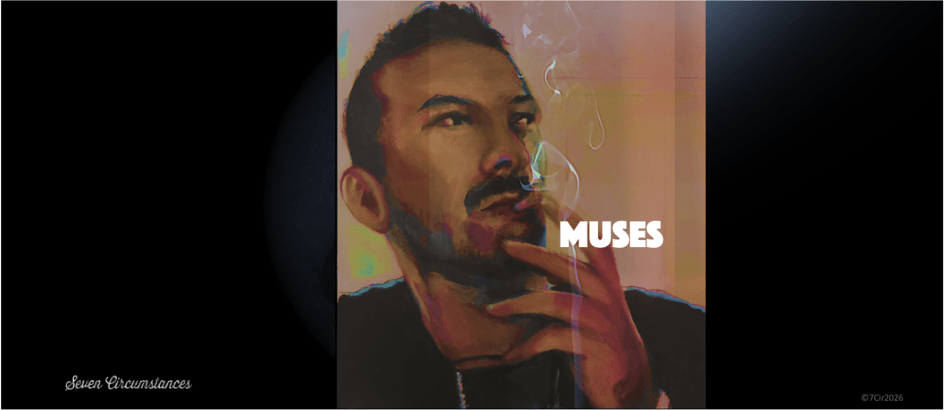
I too, have a muse, who has inspired me to make portrait paintings, write poems, and, especially, write songs for the past two years, ever since I met him – Sean Berchik. Our connection, the reason for it, is language. He “speaks Music” (yes, Music is both a langue and a parole), and I can understand him, and vice versa. How he thinks about music, how he translates his ideas and processes into compositions and lyrics, and the way he relates these to literature, Linguistics (yes, that too), poetry, and art, are hugely inspirational.
We both know that others would probably not understand a word of what we talk about, having developed this coded, esoteric way of communication, and (terrible) in-jokes. And he is very witty, and handsome. Lucky for me, he is quite used to this sort of scrutiny, attention and exposure. And also luckily, he seems to be flattered by what I create because of him. Needless to say I owe him a debt of gratitude too large to ever repay.
The artist’s eye – not A.I.
Inspiration and the drive to create, come from the strangest places. One never knows what might push you to make something. My inspiration has often been the fact that I could not get any of the paintings of him right. Failure as an impetus, in other words. Time after time, they flopped. (Man, there have been a lot of big black garbage bags full of flops!) Either they did not look like him, or they did not show his attractiveness, or my technique was poor, and the image ended up in the Uncanny Valley. I am not just learning to paint faces with every portrait I painted – I am learning what makes the human face recognizable, in other words, what makes the difference between the real person, and the image of them.
The answer is: the artist’s eye – what happens in my mind while I am painting, what I see, and what I imagine.
This is actually because, in the end, the paintings are interpretations, not photos of people, and not A.I. In each painting, something is different from reality – I left something out, or added it, or changed it, or over- or under-emphasized it, or whether those changes are subtle or obvious. He is my subject, but as I see him. As a result, the paintings also say something unique about me, and that cannot be generated out of the blue by A.I. either. (Nick Cave explained this very well, when the controversy about A.I. went mainstream.) This is the difference also between people who are copyists – who do not insert themselves into what they produce – and artists.
Muses are tolerant
Being a muse is not easy, or commonplace. But he likes what I’ve made of him. There is very little not to like about him, though. Depicting him to look good hasn’t been a stretch. Nor was writing the poems about him. Now, after more than two years, I can reveal some of what I have made, thanks to his inspiration.
Do you have a muse? Do you have someone who models for you, or inspires you, lends you their voice, or works with you on your creations? Drop me a comment, because the whole muse thing sometimes makes me feel like one lonesome tree on a windswept prairie, sticking out all by myself.

 SEVEN CIRCUMSTANCES
Do you have a muse?
What is a muse? Do artists have muses these days? Definition: Muse (person): muse noun; [uk /mjuːz/ us /mjuːz/]; a person, or an imaginary being or force that gives someone ideas and helps them to write, paint, or make music. By this definition, many famous artists have had muses, male and female. The term is derived from the “Muses”, the ancient Greek goddesses of inspiration.
Muses can be models for specific paintings and sculptures, or for characters in literary works, but sometimes not, rather providing inspiration for the artist’s body of work. A muse and an artist can be in a relationship, or not. But one way or another, a muse is someone who is outstanding in some way, with a special connection to the artist. This connection can be shared ideas, or thought processes, or similar creative impulses. Or, having opposing, but attractive, points of view. Sometimes, the muse is an artist in their own right, or collaborates with the artist on projects rather than being an influence or source.
These are muses for every art form
When you look at people who have been muses, you have to consider the impact that they had on the artist. What did they inspire or influence, and how? What did the artist produce as a result of the collaboration? Memorable muses, male and female – in random order – include:
Literature
Varvara Bakhmeteva (for Mikhail Lermontov),
Beatrice Portinari (for Dante Alighieri’s La Vita Nuova and The Divine Comedy),
Zelda Fitzgerald (for F. Scott Fitzgerald),
Neal Cassady (Jack Kerouac’s On the Road),
Alice Liddell (for Lewis Carroll),
Maud Gonne (for W.B. Yeats)
Michelangelo Buonarroti is listed here for his poetic muses, of whom there were two prominent persons. He had more muses for his visual art works:
Tommaso dei Cavalieri (for the more than 30 poems and numerous drawings of Michelangelo Buonarroti),
(left) Vittoria Colonna (for the poetry of Michelangelo Buonarroti)
Lord Alfred Douglas (for Oscar Wilde),
George Lewes (for George Eliot, real name Mary Ann Evans; he was the inspiration for her pseudonym and much of her work),
Tom Lefroy (for Jane Austen, specifically “Mr. Darcy” in Pride and Prejudice),
Arthur Hallam (for Alfred, Lord Tennyson),
Antinous (for Emperor Hadrian, Roman emperor from 117 to 138 AD),
Aline Bernstein (for Thomas Wolfe)
Art & Design
Obviously, for portrait paintings, there are too many famous muses, or models, to mention, but…
Elizabeth Siddal (for the Pre-Raphaelite Brotherhood),
Camille Claudel (for Auguste Rodin),
Theo van Gogh (Vincent’s brother, for Vincent van Gogh ). Below, “Portrait of Theo van Gogh”, by Vincent van Gogh, 1887,
Gala (for Salvador Dalí),
Dora Maar (for Pablo Picasso),
(Left) Lenka (Leonora Moltema) (for Vladimir Tretchikoff),
Victorine Meurent and Méry Laurent (for Édouard Manet and others),
Annabelle Neilson (for Alexander McQueen and John Galliano)
Music & Film
(Left) Marta Złakowska (for British trip-hop artist Tricky),
Marianne Ihlen (for Leonard Cohen, of course)
Josephine Brunsvik (for Ludwig van Beethoven – there’s a good chance she was his “Immortal Beloved”),
Yoko Ono (for John Lennon),
Pattie Boyd (for Eric Clapton and George Harrison),
Uma Thurman (for Quentin Tarantino)
(Above) Pattie Boyd, nicknamed “Layla”, and a few words from a love letter that Eric Clapton wrote to her in 1970, when she was married to George Harrison. Go to the link on the BBC page, above, to read extracts of his letters, some quite heartbreaking. His language, and cursive script, are impeccable, don’t you think?
A lifetime of inspiration
Muses can inspire a whole body of work, numerous paintings, book after book, poem after poem. They are more than models, they inspire the artist time and again, and it can last many years.
Norwegian Marianne Ihlen was Leonard Cohen’s most famous, and most important, muse. (Leonard Cohen is a songwriter and poet who I greatly admire, along with Tom Waits, Nick Cave, and Mac Miller.) They met in the early 1960s, and dated for a few years, and then developed an intense, lifelong relationship in which she was his muse. She inspired some of his most memorable songs, like like “So Long, Marianne” and “Bird on the Wire”. Her influence on his early work and persona was profound, and lasted his whole life.
Below, is a letter that he wrote to her shortly before her death in July 2016, at the age of 81. Cohen himself died not long after, in November 2016, at age 82.
If that doesn’t just put a lump in your throat with its beauty, check that you still have a heart.
A shared language
I too, have a muse, who has inspired me to make portrait paintings, write poems, and, especially, write songs for the past two years, ever since I met him – Sean Berchik. Our connection, the reason for it, is language. He “speaks Music” (yes, Music is both a langue and a parole), and I can understand him, and vice versa. How he thinks about music, how he translates his ideas and processes into compositions and lyrics, and the way he relates these to literature, Linguistics (yes, that too), poetry, and art, are hugely inspirational.
We both know that others would probably not understand a word of what we talk about, having developed this coded, esoteric way of communication, and (terrible) in-jokes. And he is very witty, and handsome. Lucky for me, he is quite used to this sort of scrutiny, attention and exposure. And also luckily, he seems to be flattered by what I create because of him. Needless to say I owe him a debt of gratitude too large to ever repay.
The artist’s eye – not A.I.
Inspiration and the drive to create, come from the strangest places. One never knows what might push you to make something. My inspiration has often been the fact that I could not get any of the paintings of him right. Failure as an impetus, in other words. Time after time, they flopped. (Man, there have been a lot of big black garbage bags full of flops!) Either they did not look like him, or they did not show his attractiveness, or my technique was poor, and the image ended up in the Uncanny Valley. I am not just learning to paint faces with every portrait I painted – I am learning what makes the human face recognizable, in other words, what makes the difference between the real person, and the image of them.
The answer is: the artist’s eye – what happens in my mind while I am painting, what I see, and what I imagine.
This is actually because, in the end, the paintings are interpretations, not photos of people, and not A.I. In each painting, something is different from reality – I left something out, or added it, or changed it, or over- or under-emphasized it, or whether those changes are subtle or obvious. He is my subject, but as I see him. As a result, the paintings also say something unique about me, and that cannot be generated out of the blue by A.I. either. (Nick Cave explained this very well, when the controversy about A.I. went mainstream.) This is the difference also between people who are copyists – who do not insert themselves into what they produce – and artists.
Muses are tolerant
Being a muse is not easy, or commonplace. But he likes what I’ve made of him. There is very little not to like about him, though. Depicting him to look good hasn’t been a stretch. Nor was writing the poems about him. Now, after more than two years, I can reveal some of what I have made, thanks to his inspiration.
Do you have a muse? Do you have someone who models for you, or inspires you, lends you their voice, or works with you on your creations? Drop me a comment, because the whole muse thing sometimes makes me feel like one lonesome tree on a windswept prairie, sticking out all by myself.
More to follow…
Share this: