Marguerite Yourcenar wrote so beautifully about the grief of Roman emperor Hadrian at the death of his lover, Antinous (also called Antinoös, (/ænˈtɪnoʊʌs/; Ancient Greek: Ἀντίνοος; c. 111 – c. 130) that it is unforgettable. And when I think of the pain that comes from loving someone but not being able to be with that person, or not acknowledging that love, I always think of Hadrian and Antinous. Not “Romeo” and “Juliet”, nor “Ophelia” and “Hamlet”. Nor any other pair of doomed lovers, real or fictional.
This statue of Antinous was discovered in 1894 at Delphi, Greece, during excavations near the Temple of Apollo. Made around 130 AD. I wonder whether those labourers knew what they were looking at. (Wikipedia retrieved 2026-01-24)
The image that stays with me is of the immensely powerful emperor, conqueror of worlds, and the humble young man, about whom next to nothing is known, who loved him. For that young man, who drowned himself when he realized that his love for Hadrian would never be reciprocated, Hadrian wanted to put up sculptures made of an idealized Antinous, to turn him into a god, and to build a city in his name.
What we feel
So when I wrote a poem about the heartbreak that comes from unrequited love, and hidden love, for my book, Soul Collective, I wrote about Hadrian and Antinous.
Grief
Antinous is dead,
and Hadrian grieves
for the dark moons of his eyes
and his shoulder-blade wings,
his smooth, slender chest,
his laugh, free of guile,
and his face, a pale lily
in the mud of the Nile.

Antinous is dead,
and there is no meaning
to the dread shattering,
the sudden end of being.
The emperor's finger
marks in ash his mistake:
He loved him too little
and told him too late.
What is left now, of the Roman Empire, and the edifices dedicated to Hadrian and to Antinous, after all these centuries? Just a few ruins, sculptures and statues, and the bitter sensation of regret that you get when you look at them. Every time I see the perfect features of the sculptures of Antinous, I think of how important it is to really see, and know, and acknowledge the ones you love. What did he really look like, I wonder, and what did he really think and feel?
Marguerite Yourcenar’s Memoirs of Hadrian is Biographical Fiction of course, but I like to think that her extensive, decades-long research showed her some truths – one of which is that Antinous did not know that Hadrian did in fact love him, and knowing had been a matter of life and death.

 SEVEN CIRCUMSTANCES
Marguerite Yourcenar wrote so beautifully about the grief of Roman emperor Hadrian at the death of his lover, Antinous (also called Antinoös, (/ænˈtɪnoʊʌs/; Ancient Greek: Ἀντίνοος; c. 111 – c. 130) that it is unforgettable. And when I think of the pain that comes from loving someone but not being able to be with that person, or not acknowledging that love, I always think of Hadrian and Antinous. Not “Romeo” and “Juliet”, nor “Ophelia” and “Hamlet”. Nor any other pair of doomed lovers, real or fictional.
This statue of Antinous was discovered in 1894 at Delphi, Greece, during excavations near the Temple of Apollo. Made around 130 AD. I wonder whether those labourers knew what they were looking at. (Wikipedia retrieved 2026-01-24)
The image that stays with me is of the immensely powerful emperor, conqueror of worlds, and the humble young man, about whom next to nothing is known, who loved him. For that young man, who drowned himself when he realized that his love for Hadrian would never be reciprocated, Hadrian wanted to put up sculptures made of an idealized Antinous, to turn him into a god, and to build a city in his name.
What we feel
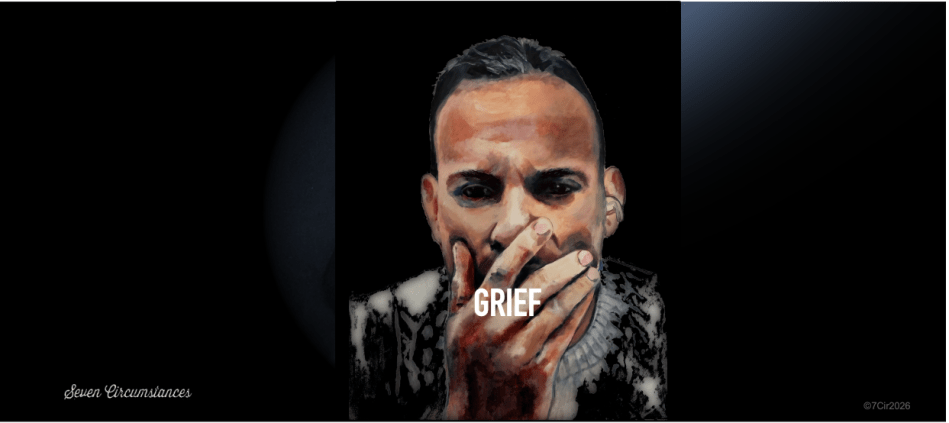
So when I wrote a poem about the heartbreak that comes from unrequited love, and hidden love, for my book, Soul Collective, I wrote about Hadrian and Antinous.
Grief
(Above: Painting and poem from Soul Collective, by Marthe Bijman, 2nd ed., July 2025, p. 18. Painting: Cat. #47, acrylic and pen on board. ©Painting & text, 2025 Martha Bijman)
What is left now, of the Roman Empire, and the edifices dedicated to Hadrian and to Antinous, after all these centuries? Just a few ruins, sculptures and statues, and the bitter sensation of regret that you get when you look at them. Every time I see the perfect features of the sculptures of Antinous, I think of how important it is to really see, and know, and acknowledge the ones you love. What did he really look like, I wonder, and what did he really think and feel?
Marguerite Yourcenar’s Memoirs of Hadrian is Biographical Fiction of course, but I like to think that her extensive, decades-long research showed her some truths – one of which is that Antinous did not know that Hadrian did in fact love him, and knowing had been a matter of life and death.
Share this: