
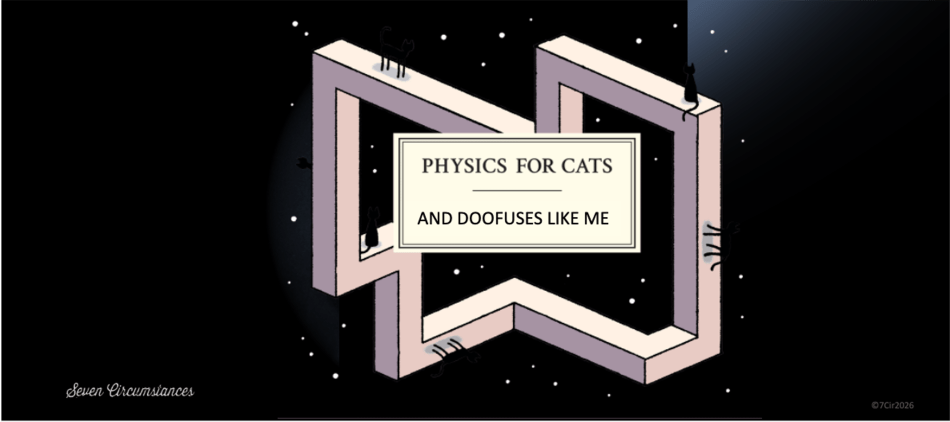
I admit that I suffer from dyscalculia, a learning disorder that affects a person’s ability to understand, process, and work with numbers, often referred to as “Math Dyslexia”. Is it Maths or Math? I don’t know. I don’t care to find out. I do not have word dyslexia, in fact I’d say I have a talent for working with words. But numbers? The opposite. The results have never been good.
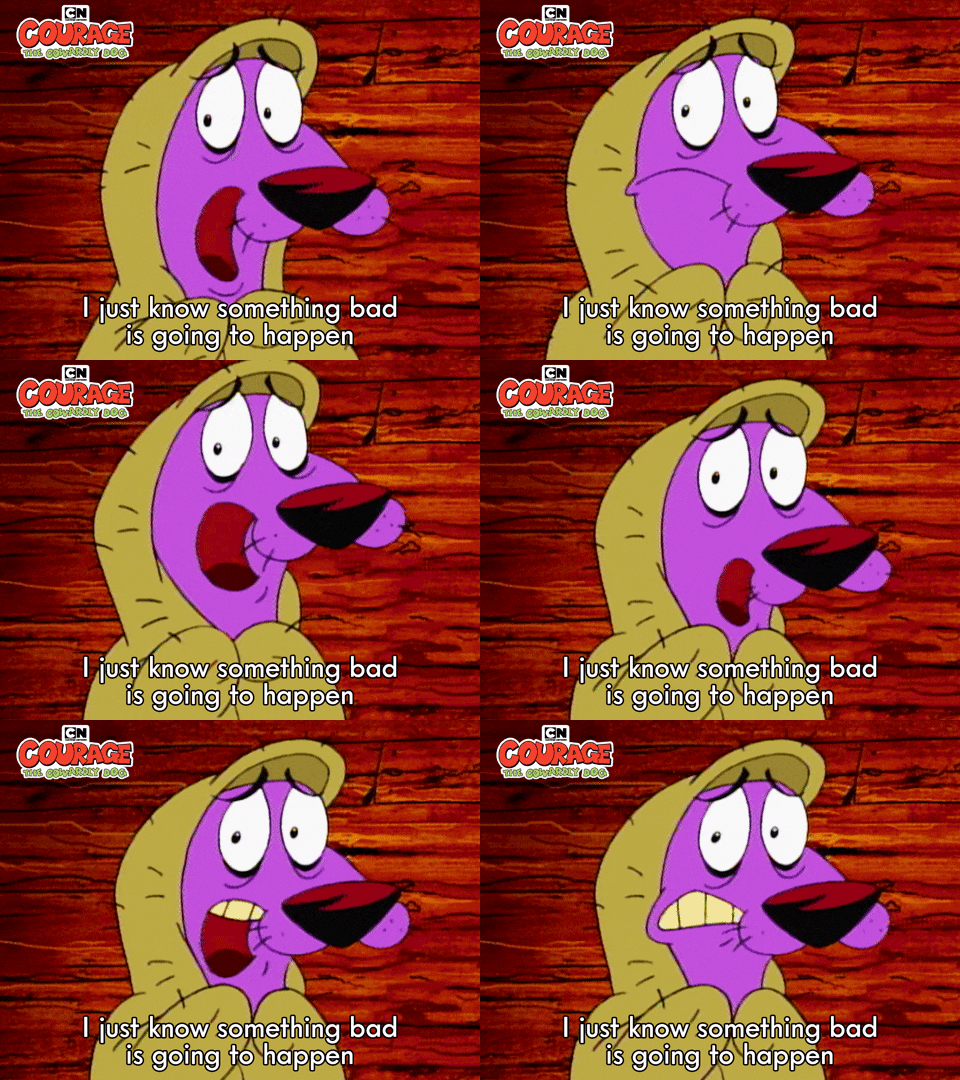
I don’t know Maths or Physics
For years I thought that this blind spot is just me being uneducated. I mean, I literally failed Maths very year at school, right through to junior high. I got A grades for Art and Languages, and the lowest possible grades for Maths. You don’t think it is possible to get graded a “G”? I did. It is embarrassing, but I am bad at anything that involves numbers and calculations. Estimation and measurements defeat me. Division and multiplication defeat me. Needless to say, since Physics is a lot about numbers, I did not take Physics as a subject in high school. I ended up being a half-educated adult.
Cue the review👇
What the almighty hatstand is THAT??
The Fates spared me the entire roster of dysfunctions. Nevertheless, I am a complete doofus about Physics. Therefore, why would I, Little Miss Stubbornly Confused, read an entire book of cartoons about Science in general and Physics in particular?
Well, because it promised to be funny.
The way humour works is through contrast. If something is noticeably contrasting with the norm, or strange, or shocking, the person who takes it in is discomforted, and feels threatened, until they realize it’s not real, and not them, and then, being relieved, they smile or laugh. Thanks to Google’s A.I., here is the duly scientific explanation based on one of the main three causative theories:
“Humor works as a complex psychological and social response, but is primarily explained by the benign violation theory, which posits that something is funny when it is perceived as both wrong or a violation of social norms and, simultaneously, harmless or safe.”
Tah-dah. This means that if a joke or anecdote by a comedian is not perceived as sufficiently wrong or discomforting by their audience, the audience will not laugh. Humour, per definition, cannot be politically correct. Its subversiveness or strangeness makes it funny. Reacting with; “…what the almighty hatstand is that?”, is actually a good start to appreciating a joke.
And this is why, Dear Reader, I laughed my head off at Physics for Cats ― Science Cartoons, by Tom Gauld.
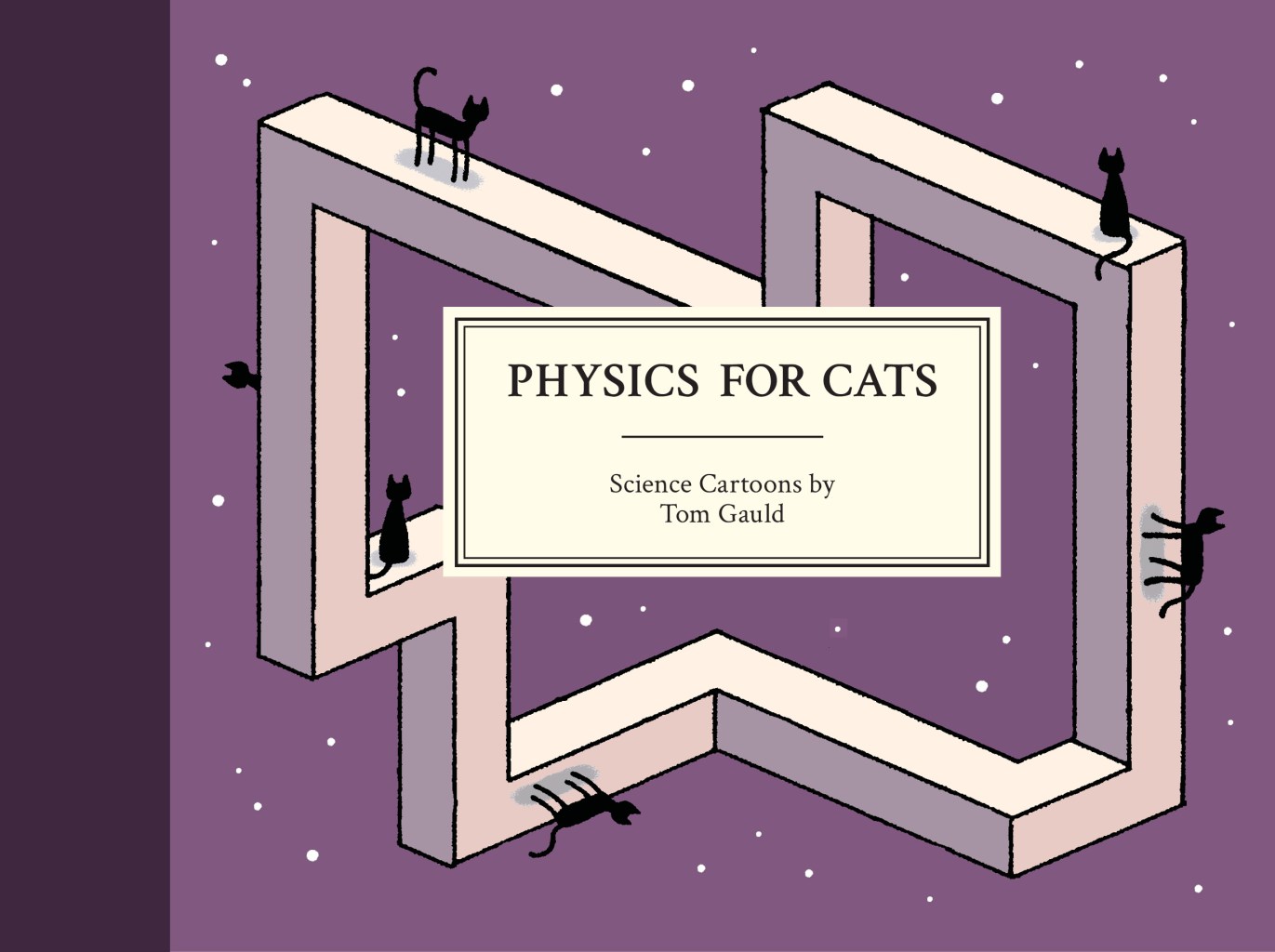
Given my “-tisms”, the first few cartoons were, at first glance, obtuse, and a bit worrying. Then, the humour kicked in. Because of the way he draws it, and the speech bubbles and text that he puts in, the joke becomes clear, and then I feel relieved and amused. The weirder the science fact, the funnier it got. And when I did understand the reference in the cartoon and it made me giggle, I felt rather superior. And this book has no text. It’s just 160 pages of cartoons on every page.
These cartoons are particularly clever in five ways:
1) the twisting of established parameters to stimulate amusement;
2) the play-on-words, puns, sarcasm, rhymes, and other wordmongering ways;
3) the inventive combinations of ideas;
4) the highly imaginative creations – I mean, how would YOU draw an “experimental synthetic life form”? – and,
4) the graphical representations of those ideas that are, themselves, jokes. Sometimes I had to Google some of the things. Sometimes I had to study the cartoon quite a while before the penny dropped.
By the time I finished the book, I felt as if my Doofus-ness had been somewhat reduced. I felt kind of chuffed that I had understood quite a bit. And of course, I had enjoyed laughing out loud, which is very therapeutic.
To cut a long story short: It’s very funny, it’s very clever, and I really enjoyed it, and so will you.
Since the entire book consists of cartoons…
The book is all Tom Gauld’s carefully drawn cartoons (so carefully that he even uses different typefaces to lead you to the meanings), and they look quite simple with flat colours and minimal shading – but they are rather like Hergé’s famous ligne claire style. It is easy to identify a Tom Gauld cartoon by the way it looks.
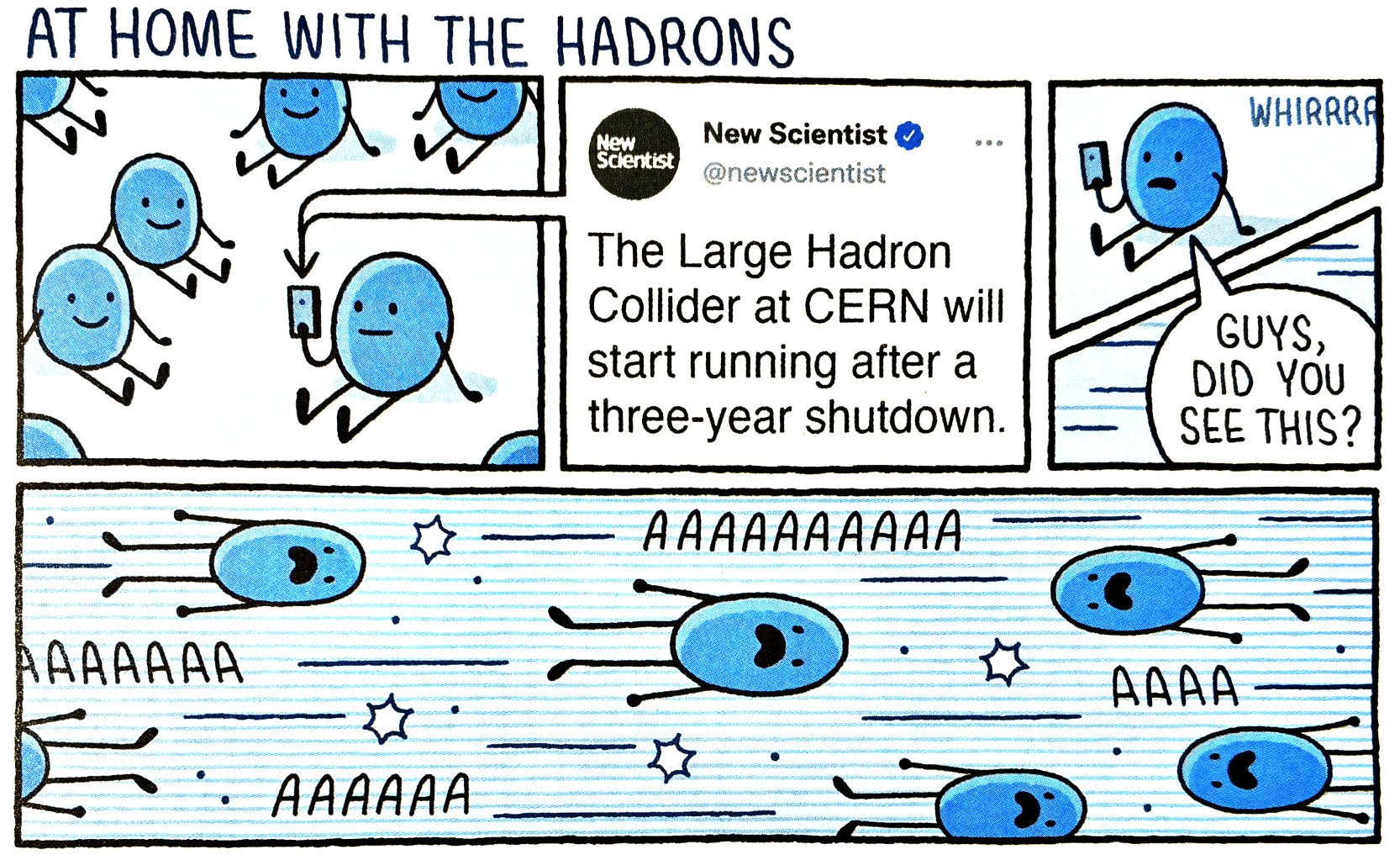
For the purposes of this review, I am including just three that particularly amused me.
I suggest you buy it and read it. I get my dose of Tom Gauld every so often on IG and I must say, by now I am both a follower and a fan. And by the way, you can actually buy the cartoon artwork on his website.
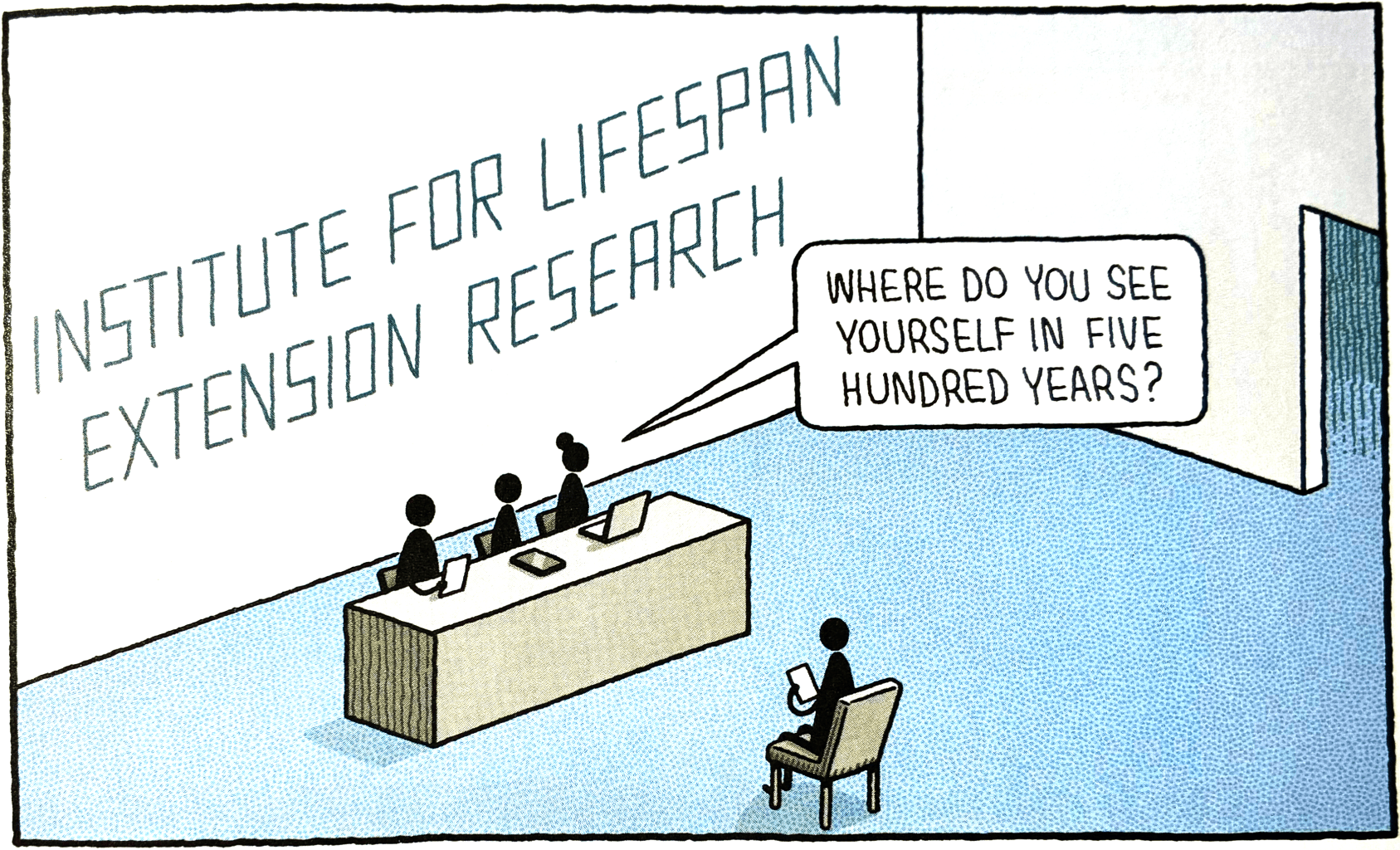
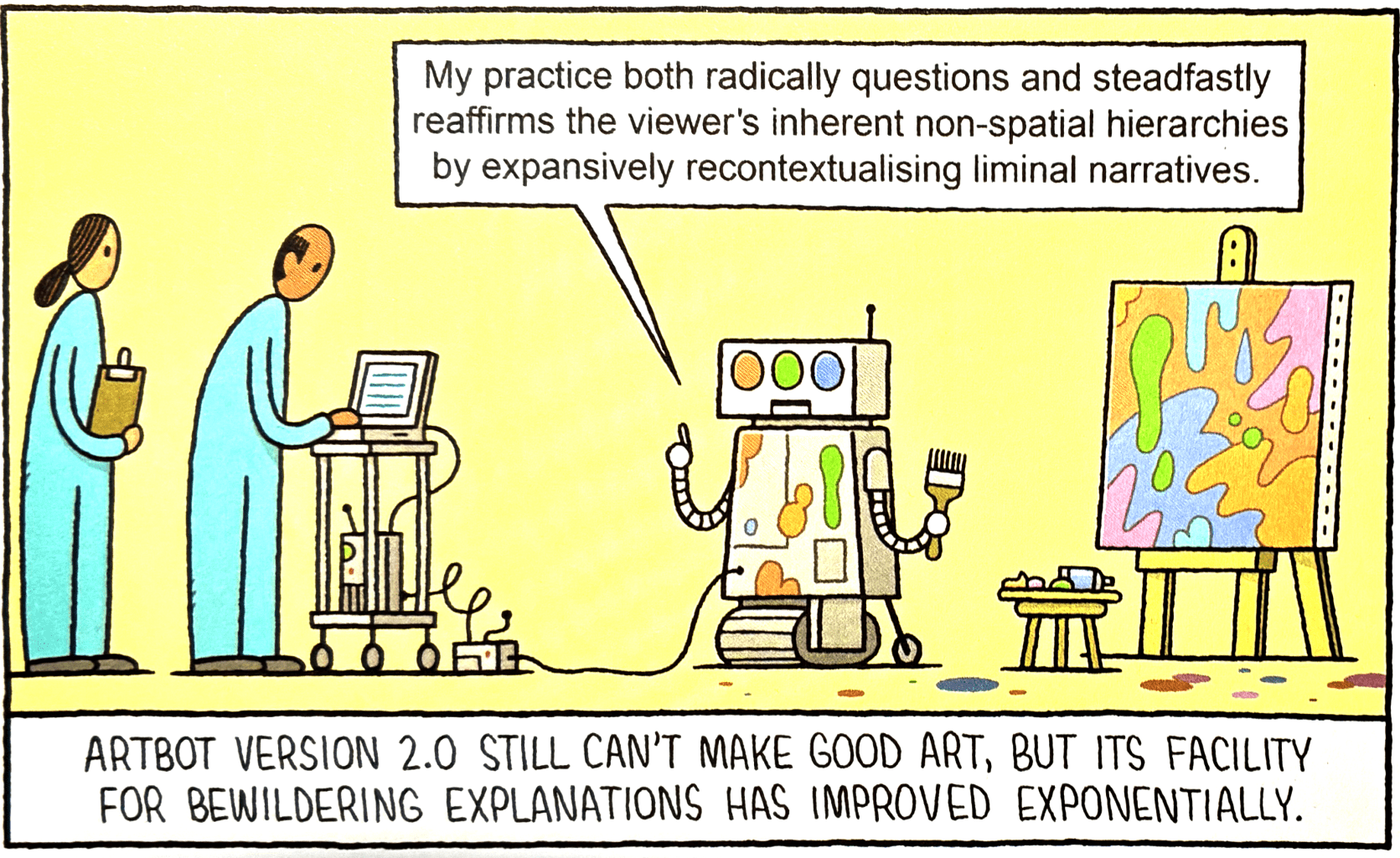
PS Did you see my mistake up there? “The cartoons are particularly funny in five ways”, “…1… 2… 3… 4… 4…” Yes, I really wrote that, only noticed it just now, but it proves my point, doesn’t it? And nevertheless, Tom Gauld’s cartoons amuse me.
 SEVEN CIRCUMSTANCES
Ja, ek het die 4) … 4) opgemerk … Maar as ‘n ma wat aan die slaap geraak het (🙄) terwyl sy haar laerskoolseun probeer help het om vir ‘n wetenskaptoets te leer, gaan ek wye draaie om hierdie boek loop – anders as met “The Boy, the Horse, the Fox and the Mole”, toe ek wel jou aanbeveling gevolg het, tot my innige plesier.
Haha! Dis te verstane! Maar ek’s bly jy het gehou can Charlie Mackesy se boek.