
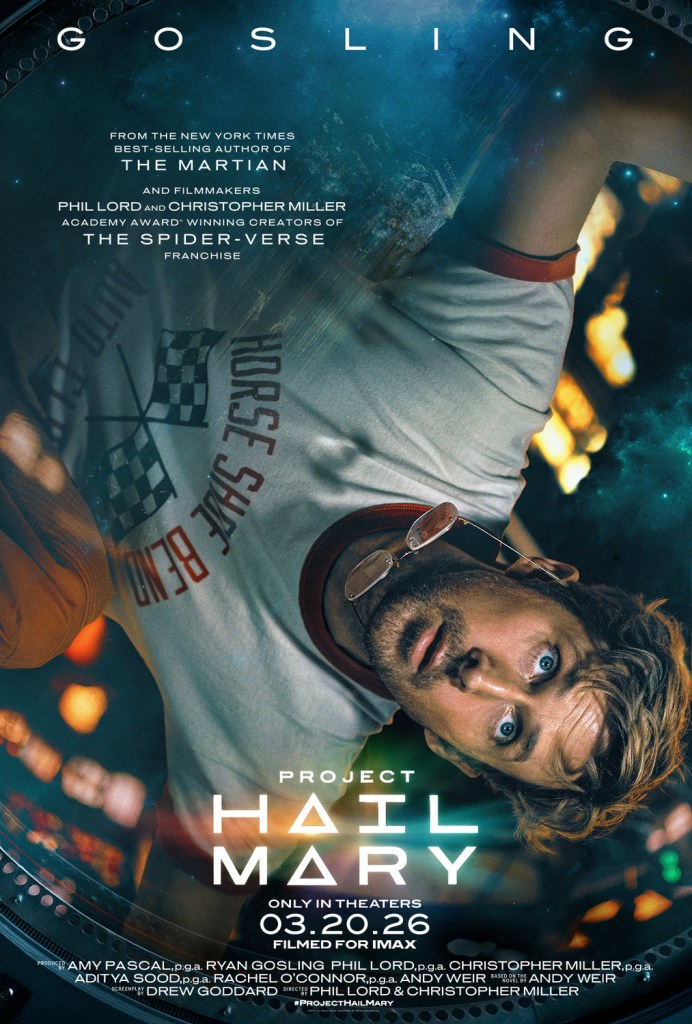
The film, Project Hail Mary, based on Andy Weir’s novel of the same name, has been released, and judging by the feedback, one of the things that I feared would happen, has happened, namely: the public, and reviewers, do not understand what this film is about. The stupidest review I’ve seen is a rant that the science in the film is impossible, that it can’t happen. Outrageous! the reviewer fumed. How dare they tell such lies in the movie!

No, people. Your criticism is irrelevant. This is not a documentary or an educational film about rocket science. It’s a narrative motion picture based on a Science Fiction novel. It’s fiction, made up, imagined, thought up by Andy Weir. The very word, “fiction”, tells you that:
fiction / noun / fic·tion ˈfik-shən / : something told or written that is not fact / : a made-up story / fictional -shnəl -shən-ᵊl adjective / fictionally -shnə-lē -shən-ᵊl-ē adverb.
Weir took known facts about space travel and the universe, and then expanded those facts far into the realm of conjecture or possibility. That’s what you do in Science Fiction.
You might be reading this and going; Nah, I wouldn’t do that. I know how these things work. Do you? Really? Read on. It gets interesting.
Get your expectations straight
Screenplays and novels are fit somewhere on the sliding scale between realism – real world facts – and fantasy. When you go see a drama, you should expect that it isn’t going to be documentary. The same goes for poetry, lyrics, and paintings – they are creations from the mind of the artist, some more abstract than others, but none are meant to be entirely factual or true. If the writer did mean it to be factual and true, then they would produce a documentary, write a handbook, or publish a report, and what they say it is would be clearly stated on the title page and in the credits.
Yes, I understand that this can be confusing. In every work of art there is the author’s voice that is trying to tell us something, and that relates to the real world and whoever will enjoy the art. When the protagonist is a first-person narrator (I, me, etc.) it makes it even more difficult. And, in order to connect, there has to be some realism, some relevance, and some consistency with the non-digital world. But the manner in which the author or creator departs from these criteria, is what makes it art, and what makes it unique.
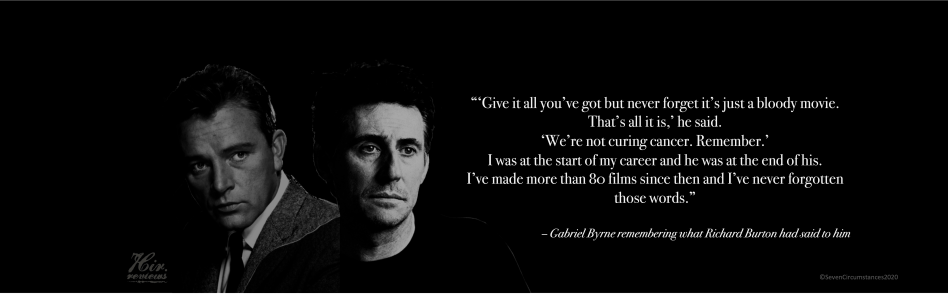
“It’s just a bloody movie…”
What makes the argument of bad science in Project Hail Mary worse, is that thing that people do of conflating the dialogue spoken by the actors, with the words in the screenplay or script. Ryan Gosling, or whoever, did not write, or believe, or stand for the words in the movie.
The actor reads or performs the lines that are written by someone else. The craft and art of an actor is acting, which requires memorization skills, and the ability to imitate life. It’s what they do, their method, and the better they do it, the more convincing their performance becomes. But they are not the character that they portray on screen (unless by some rare coincidence).
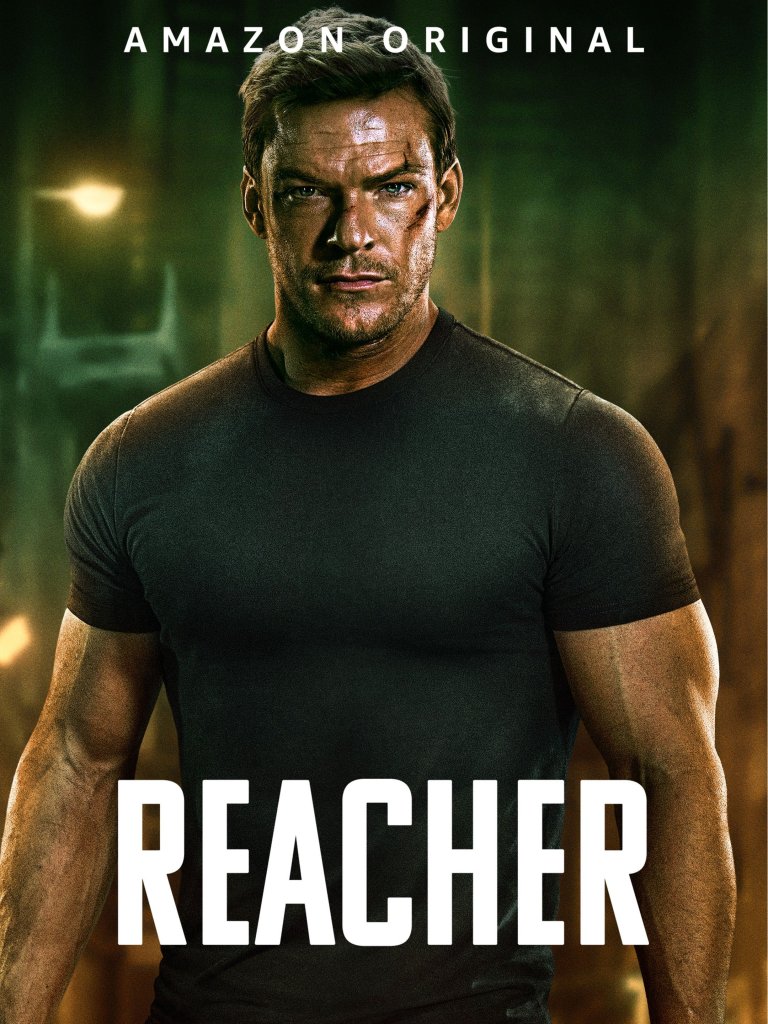
For example: yesterday on the news (March 23, 2026) there was a story that the actor Alan Ritchson, had “beaten up his neighbour in a road rage incident”. Then the stories followed that it was more like a spat. The actor may be 6 ft-something tall, but in real life it is unlikely that he goes around regularly attacking and killing people. The only reason that the story made headlines is because people think he is like the character he plays, “Reacher”. He’s not. He is an actor. The story probably got published because Reacher, Season 4, is coming out soon. But any publicity is good publicity, right? Nope.
It’s not necessarily what the performers believe
Many consumers take what performers do very seriously. They identify with the words or the roles. They like to think that the fictional characters are real. They even go and visit the places that authors describe in their novels. They listen to the lyrics of a song and think that the artist has written something deeply personal and truthful. No, that’s not how it works.

For instance, Taylor Swift’s lyrics, while they are created from, or inspired by, elements in her life, are not intended to reveal her literal opinion of her former lovers. They are co-written by her and Jack Antonoff, and then they are massaged into genre-format by her producers, one of whom is the famous Max Martin.
To put it plainly, by the time it reaches your ears, the lyrics to her songs, like all the lyrics of every song ever published, are pretty much an allusion. They are the result of the transfer of a revelation to the listener’s nucleus of intuition and emotion. By transforming the lyrics in this way, you, the listener, gets to identify with Taylor Swift’s lyrics and her songs. Lyrics are not, and should not be, diary entries or confessionals. It makes them non-relatable.
It drives me crazy, uh uh, like nothing else, uh uh…🎶
My misquote, above, of the lyrics by Fine Young Cannibals, refers to a related problem that also drives me nuts: All the time on Instagram, people publish clips of actors reciting some lines, and then go on about how significant and beautiful what they say is. And everyone goes nuts and loves, loves, loves the OP as well as the actor. The likes run to thousands, and for what? Those words, beautifully spoken as they are, were likely not written by the actor, nor sung by the performer. (In fact, actors who also wrote the original screenplay for a movie in which they acted, are rare.)
They were written by a screenwriter, whose name is hardly ever mentioned. In Project Hail Mary, these behind-the scenes people are Drew Goddard and Andy Weir.
I have to go check it out
Last week, I saw a fascinating video clip on IG, one of these with no credits given, and no original source. It was a grainy, blurry, black-and-white video of people being blown about by a strong wind. It looked like they were dancing on ice.
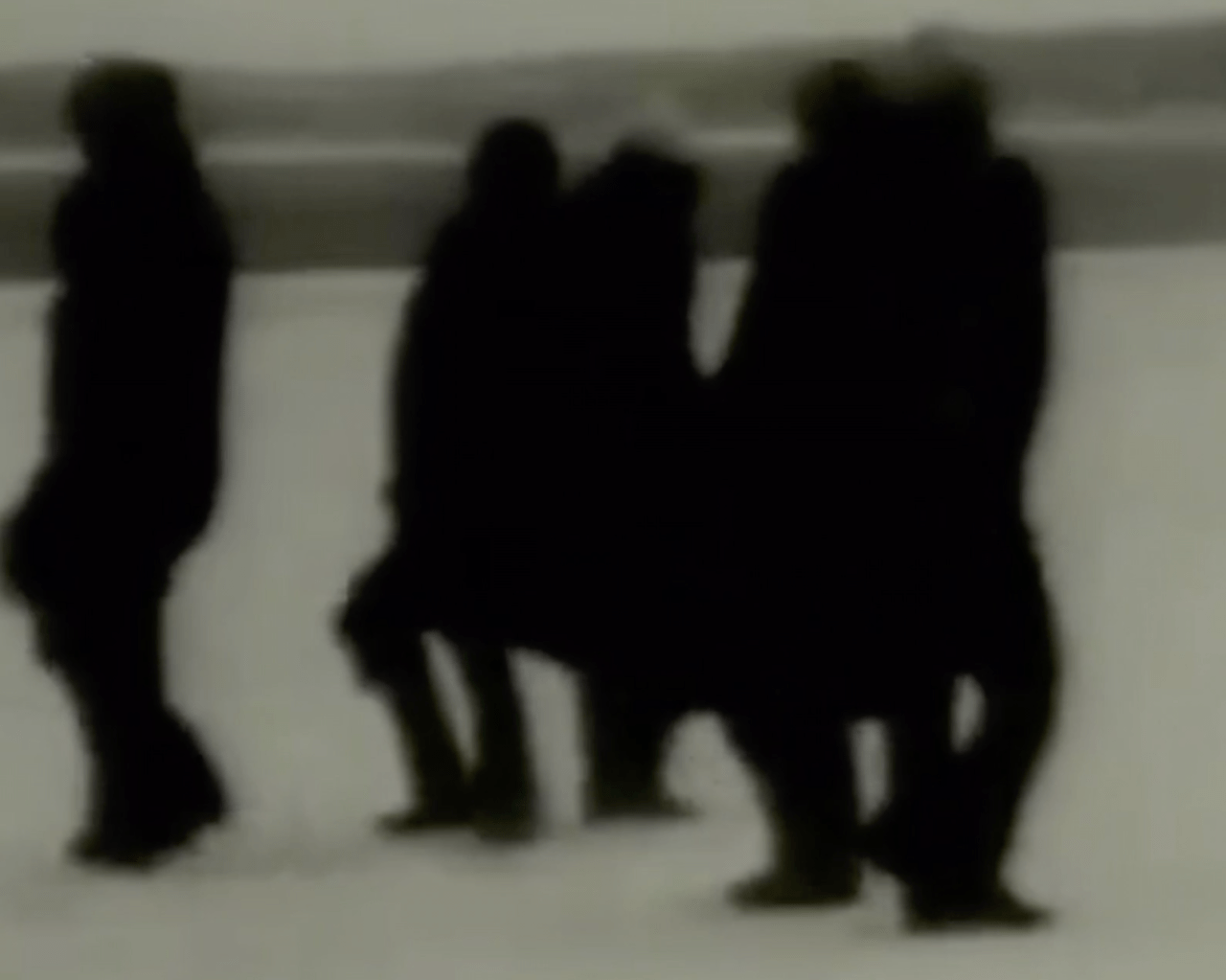
I subsequently saw it used, without any references, in many YouTube videos and on many other platforms. I wanted to see the original and find out who made it, so I did some detecting. I found out, after emails to European museums and agencies, that it a film by Joan Jonas, called Wind, made in 1968, 5 min. 4 seconds long, archival no. R.2953. It is one of the pieces in her multimedia-type art, and you must pay royalties to use it.
Everything that exists, has a maker. You need to acknowledge that person – and that’s a fact.
So every time this happens on IG, Facebook, YouTube, etc., I have to go sleuthing and go into IMDB, Wikipedia, or Grokipedia, to check who was the writer or writers of that episode in the TV show, or that scene in the movie, and whether they based their script on a pre-existing book. I catch myself joining in (due mostly to my weakness for all things James Bond and Star Trek) going, Oooh! that’s great! Adding a ❤️ and forgetting that there is a faceless writer-for-hire who wrote and owns those words. By now it’s like a game of Whack-A-Mole.
You, posting the contents that gives you all those ❤️ and those fawning comments full of emojis, are in fact making your followers cheer for someone they don’t even know exists and therefore with whom they cannot identify. And, worse, WHOM. YOU. DID. NOT. CREDIT. Yes, they were likely paid to do it, but in terms of who the creative must be acknowledged to be, it is that writer.
Writers have rights
For example, when you publish a song, the platform asks you to record (for perpetuity) separate names: the names of the songwriters; then the names of the artists and creatives; then the names of the performing artists. The songwriters – the writers – is the most important category. The people in the music industry realize that these are different roles when a song gets produced, and that the people get separate credits for their roles.
Next time you download or stream a song, right-click and get the Info about it or to view the credits, and check who’s the performing artist, the album artist/writer, and the composer. You’ll be surprised who gets credited for what. It might be all the same person, like in the example below, or the artist by their real name, or different people altogether.
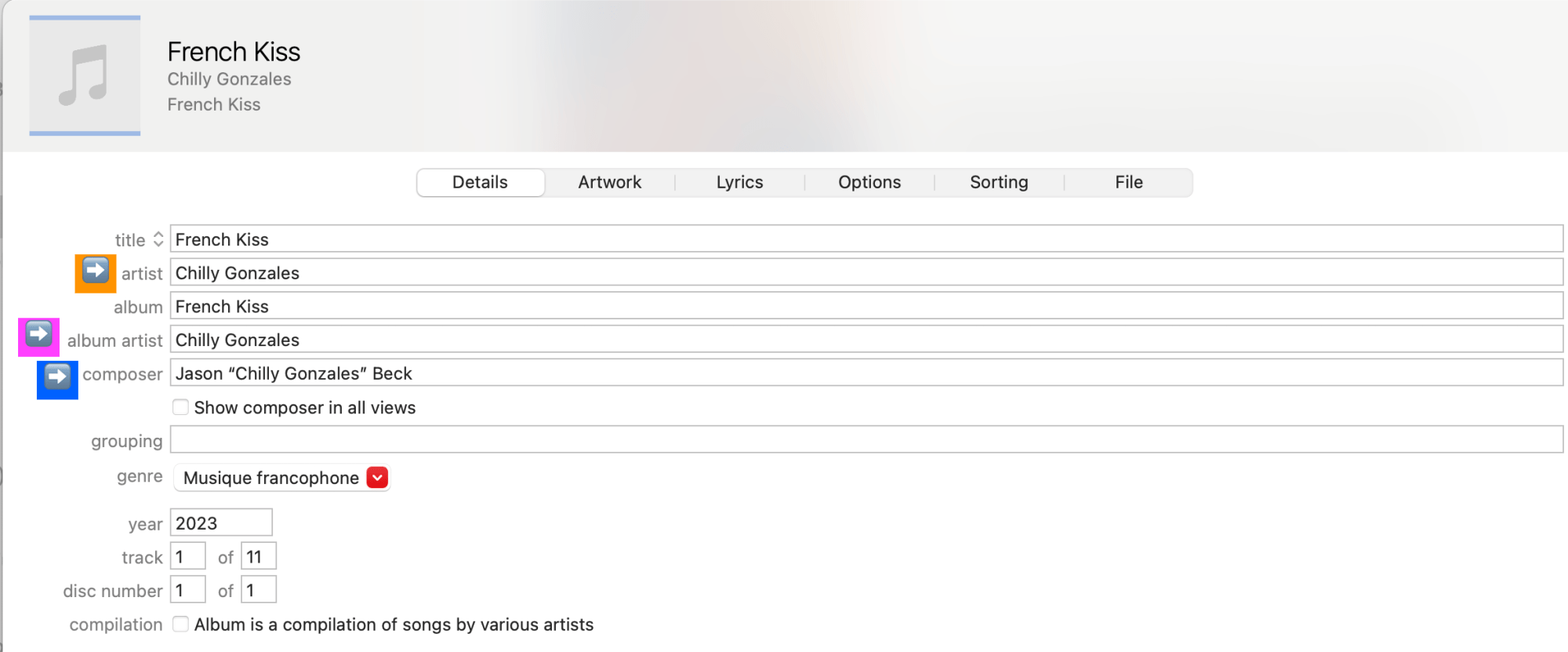
(Isn’t it ironic that the people in the music industry who require precision and complete disclosure when artists publish music, to give songwriters their due in terms of credits, royalties, and splits, also developed the systems that rip off that original music and have it chopped into little bits for A.I.-generated background muzak?)
Got to tell you, folks, those inappropriately appropriating OPs and their feeds, I block them and unfollow them. We should all give credit where it is due (and don’t use the excuse of “couldn’t find it out”, or, “if this work is yours, DM me”). And don’t word your post as if you or the actors wrote the lines.
And don’t forget, you commentators, reviewers, and viewers out there, narrative films are fictional.
 SEVEN CIRCUMSTANCES
0 comments on “No, no, no! For heaven’s sake, it’s not real!”