On Wednesday, April 15, the U.S., Secretary of Defence, Pete Hegseth, read what he called a prayer to attendees at a meeting at the Pentagon. He said it’s frequently used in combat search-and-rescue missions, and “They call it CSAR 25:17, which I think is meant to reflect Ezekiel 25:17”.
What’s interesting is that the “prayer” is a variation on a few lines of dialogue from the 1994 movie Pulp Fiction. It’s closer to Pulp Fiction than to the verse from Ezekiel. It’s a scene where “Jules Winnfield”, played by Samuel L. Jackson, preaches his life philosophy to the misbehaving minion of a drug lord. The minion is so scared that he poops his pants. And no wonder, since Jules, once he is quoting his favourite verses from the Bible’s Old Testament, is truly prophetic in his wrathfulness.
Comparing lines
HEGSETH
(Changes from the Pulp Fiction script are shown in italics.)
“The path of the downed aviator is beset on all sides by the iniquities of the selfish and the tyranny of evil men.
Blessed is he who in the name of camaraderie and duty shepherd [sic] the lost through the valley of darkness, for he is truly his brother’s keeper and the finder of lost children.
And I will strike down upon thee with great vengeance and furious anger those who attempt to capture and destroy my brother.
And you will know my call sign is Sandy One when I lay my vengeance upon thee. Amen”
“JULES”
“There’s a passage I got memorized, seems appropriate for this situation: Ezekiel 25:17.
The path of the righteous man is beset on all sides by the inequities of the selfish and the tyranny of evil men.
Blessed is he who, in the name of charity and good will, shepherds the weak through the valley of darkness, for he is truly his brother’s keeper and the finder of lost children.
And I will strike down upon thee with great vengeance and furious anger those who attempt to poison and destroy my brothers.
And you will know my name is the Lord when I lay my vengeance upon you.”
Tarantino uses a particular trait to make the character of Jules stand out: Jules misremembers, as the phrase goes these days. The words that he says come from Ezekiel 15:17, are what he wants them to be.
In the classic King James Version of the Bible, Ezekiel Chapter 15, lines 14 to 17, are not the same as in Pulp Fiction. One must remember that the Old Testament books of the Bible contain a great deal of slayings and begettings, because that was how life was at the time that it was written. As I found out when I put a Psalm of King David to music, in the Old Testament the same idea is often repeated with different words, if it is critical. The closest related phrase is Line 17:
Ezekiel 15: 14-17
14 And I will lay my vengeance upon Edom by the hand of my people Israel, and they shall doe in Edom according to mine anger, and according to my furie, and they shall know my vengeance, saith the Lord God.
15 Thus saith the Lord God, Because the Philistines have dealt by revenge, and have taken vengeance with a despiteful heart, to destroy it for the old hatred:
16 Therefore thus saith the Lord God, Behold, I will stretch out mine hand upon the Philistines, and I will cut off the Cherethims, and destroy the remnant of the Seacoast.
17 And I wil execute great vengeance upon them with furious rebukes, and they shall knowe that I am the Lord, when I shall lay my vengeance upon them.
(Mis)quoting quotes
Someone thought up this variation, probably because they really like the film and the meaning and emotion in the words really resonate with them. People do this particularly with dialogue from films. They repeat the quote so often that it becomes part of their own range of expressions or sayings, and then they change it, and so it goes. Eventually, a quote gets completely changed, but it becomes timeless. It can become a trope.
But I think the real reason people make lines or expressions their own is because they cannot say it better themselves.
What did the writer mean?
The words that people feel are a part of them were written by someone they probably don’t know, and who perhaps meant something different. Quentin Tarantino wrote the screenplay of Pulp Fiction. He also directed it, and plays a small role in it. Quentin Tarantino and Roger Avary wrote the story for the film. So, you can mostly thank Tarantino for these words, though the whole film is full of quotable lines.
Tarantino’s fiction writing is often cynical, about transgressive subjects, and features unconventional characters. Reading the Pulp Fiction script (there’s a link to it at the end of this post), you will notice that Jules’s rant, though delivered like he’s on a pulpit or on a political campaign rally, is actually a weak point for the character.
“Vincent” (left), played by John Travolta, and “Jules” (right), played by Samuel L.Jackson in Pulp Fiction, 1994. (Photo: IMDB, retrieved 2026-04-17)
Jules, though he likes to think of himself as his “brother’s keeper” and a “shepherd” like in the misquoted Bible verse, behaves like an evil man, and does a whole bunch of killing. As with his arguments about not eating pork, and foot massages, his thinking is not quite clear, and his sidekick, “Vincent Vega”, played by John Travolta, enjoys pointing this out to him. Tarantino’s habit of inverting characters, so that bad guys turn out to be good, and good guys bad, stupid people not so stupid, and innocents not so blameless, challenges the viewer to think a bit deeper.
That quote raises a similar philosophical point about Hegseth and the crew that uses it as a prayer of sorts: What do they think they are? Sheep, or wolves? Or both?
So you see, Secretary Hegseth was not doing something weird and wrong when he said that “prayer”. People would love to point fingers and say that he was plagiarizing or being disrespectful towards the Bible, but he and his crew were just doing what we all do – make the lines written by other people our own, because we cannot express them any better ourselves. By doing so, we make the words unforgettable.
The line about English
I noticed this bit of news because Pulp Fiction is one of my favourite films, and I really enjoy Tarantino’s writing. But the quote from Pulp Fiction that I like best, perhaps because I used to be an English teacher and am a little obsessed with grammar, is:
JULES
ENGLISH-motherfucker-do-you-speak-it?
I’m not the only one who likes that line. Norwegian DJ and producer, Matoma, made a remix with it back in 2014. Every time I hear the track (link below) I am hugely amused. I go around the house saying: “WHAT?! Say WHAT?! English, motherfucker, do you speak it?!” Ha. Small things amuse small minds.
Matoma Mix – Ludacris ft. The Notorious B.I.G – Yeah vs. Mo Money Mo Problems (SoundCloud, retrieved 2026-04-16)
More likeable lines from Pulp Fiction
BUTCH Zed’s dead, baby. Zed’s dead.
JULES You sending The Wolf?
JULES We’d have to be talkin’ ’bout one motherfuckin’ charmin’ pig. It’d have to be the Cary Grant of pigs.
HONEY BUNNY Any of you fuckin’ pricks move and I’ll execute every one of you motherfuckers!
And others
You’re saying, naw, this is so unoriginal, I don’t speak in quotes! Come on, you’ve never popped your head around a doorframe and screamed “Heeeeere’s Johnny!!”?
The American Film Institute put out a list of 100 most popular quotes from films back in 2005. Some of those lines are timeless (and often misquoted). Here are the top four quotes – a more recent list probably has different ones:
Gone with the Wind RHETT BUTLER Frankly, my dear, I don’t give a damn. The Wizard of Oz DOROTHY Toto, I’ve got a feeling we’re not in Kansas anymore.
The Godfather DON VITO CORLEONE I’m going to make him an offer he can’t refuse.
On the Waterfront TERRY MALLOY You don’t understand. I coulda had class. I coulda been a contender.
I find the Divine Language invented by director Luc Besson for the character “Leeloo”, in his very witty and imaginative film, The Fifth Element, intriguing – mind you, I love the whole movie:
Bruce Willis, as “Korben Dallas”, and Milla Jovovich as “Leeloo”, with multi-pass, in The Fifth Element, 1997. (Photo: IMDB, retrieved 2026-04-17)
LEELOO
Multi-pass!
Dan’koo.
I have two other lines that I say a lot, that come from classic cartoon series:
“Courage” having a moment in Courage the Cowardly Dog, TV Series, 1999-2002, created by John Dilworth. (Photo: IMDB, retrieved 2026-04-17)“Pinky” (left) and “The Brain” (right), from Pinky and the Brain, TV Series, 1995–1998, created by Tom Ruegger. (Photo: IMDB, retrieved 2026-04-17)
Courage, the Cowardly Dog COURAGE The things I do for love!
Pinky and the Brain BRAIN What do I want to do today? The same thing I do every day, Pinky; plan to take over the world.
PS
Here’s the actual script of Pulp Fiction, which is really entertaining to read, courtesy of dailyscript.com: Pulp Fiction script (pdf)

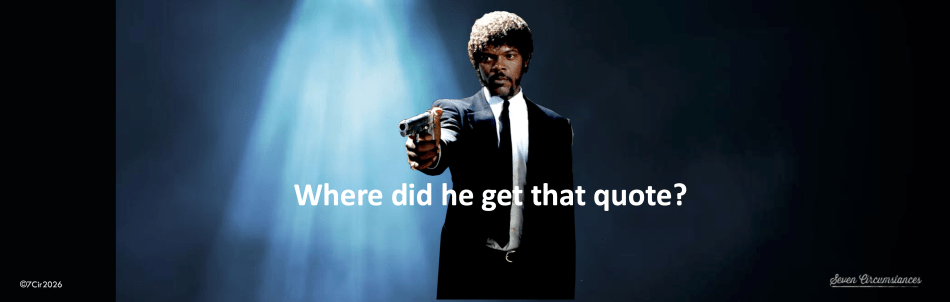


On Wednesday, April 15, the U.S., Secretary of Defence, Pete Hegseth, read what he called a prayer to attendees at a meeting at the Pentagon. He said it’s frequently used in combat search-and-rescue missions, and “They call it CSAR 25:17, which I think is meant to reflect Ezekiel 25:17”.
What’s interesting is that the “prayer” is a variation on a few lines of dialogue from the 1994 movie Pulp Fiction. It’s closer to Pulp Fiction than to the verse from Ezekiel. It’s a scene where “Jules Winnfield”, played by Samuel L. Jackson, preaches his life philosophy to the misbehaving minion of a drug lord. The minion is so scared that he poops his pants. And no wonder, since Jules, once he is quoting his favourite verses from the Bible’s Old Testament, is truly prophetic in his wrathfulness.
Comparing lines
HEGSETH
(Changes from the Pulp Fiction script are shown in italics.)
“The path of the downed aviator is beset on all sides by the iniquities of the selfish and the tyranny of evil men.
Blessed is he who in the name of camaraderie and duty shepherd [sic] the lost through the valley of darkness, for he is truly his brother’s keeper and the finder of lost children.
And I will strike down upon thee with great vengeance and furious anger those who attempt to capture and destroy my brother.
And you will know my call sign is Sandy One when I lay my vengeance upon thee. Amen”
“JULES”
“There’s a passage I got memorized, seems appropriate for this situation: Ezekiel 25:17.
The path of the righteous man is beset on all sides by the inequities of the selfish and the tyranny of evil men.
Blessed is he who, in the name of charity and good will, shepherds the weak through the valley of darkness, for he is truly his brother’s keeper and the finder of lost children.
And I will strike down upon thee with great vengeance and furious anger those who attempt to poison and destroy my brothers.
And you will know my name is the Lord when I lay my vengeance upon you.”
Tarantino uses a particular trait to make the character of Jules stand out: Jules misremembers, as the phrase goes these days. The words that he says come from Ezekiel 15:17, are what he wants them to be.
In the classic King James Version of the Bible, Ezekiel Chapter 15, lines 14 to 17, are not the same as in Pulp Fiction. One must remember that the Old Testament books of the Bible contain a great deal of slayings and begettings, because that was how life was at the time that it was written. As I found out when I put a Psalm of King David to music, in the Old Testament the same idea is often repeated with different words, if it is critical. The closest related phrase is Line 17:
Ezekiel 15: 14-17
14 And I will lay my vengeance upon Edom by the hand of my people Israel, and they shall doe in Edom according to mine anger, and according to my furie, and they shall know my vengeance, saith the Lord God.
15 Thus saith the Lord God, Because the Philistines have dealt by revenge, and have taken vengeance with a despiteful heart, to destroy it for the old hatred:
16 Therefore thus saith the Lord God, Behold, I will stretch out mine hand upon the Philistines, and I will cut off the Cherethims, and destroy the remnant of the Seacoast.
17 And I wil execute great vengeance upon them with furious rebukes, and they shall knowe that I am the Lord, when I shall lay my vengeance upon them.
(Mis)quoting quotes
Someone thought up this variation, probably because they really like the film and the meaning and emotion in the words really resonate with them. People do this particularly with dialogue from films. They repeat the quote so often that it becomes part of their own range of expressions or sayings, and then they change it, and so it goes. Eventually, a quote gets completely changed, but it becomes timeless. It can become a trope.
But I think the real reason people make lines or expressions their own is because they cannot say it better themselves.
What did the writer mean?
The words that people feel are a part of them were written by someone they probably don’t know, and who perhaps meant something different. Quentin Tarantino wrote the screenplay of Pulp Fiction. He also directed it, and plays a small role in it. Quentin Tarantino and Roger Avary wrote the story for the film. So, you can mostly thank Tarantino for these words, though the whole film is full of quotable lines.
Tarantino’s fiction writing is often cynical, about transgressive subjects, and features unconventional characters. Reading the Pulp Fiction script (there’s a link to it at the end of this post), you will notice that Jules’s rant, though delivered like he’s on a pulpit or on a political campaign rally, is actually a weak point for the character.
Jules, though he likes to think of himself as his “brother’s keeper” and a “shepherd” like in the misquoted Bible verse, behaves like an evil man, and does a whole bunch of killing. As with his arguments about not eating pork, and foot massages, his thinking is not quite clear, and his sidekick, “Vincent Vega”, played by John Travolta, enjoys pointing this out to him. Tarantino’s habit of inverting characters, so that bad guys turn out to be good, and good guys bad, stupid people not so stupid, and innocents not so blameless, challenges the viewer to think a bit deeper.
That quote raises a similar philosophical point about Hegseth and the crew that uses it as a prayer of sorts: What do they think they are? Sheep, or wolves? Or both?
So you see, Secretary Hegseth was not doing something weird and wrong when he said that “prayer”. People would love to point fingers and say that he was plagiarizing or being disrespectful towards the Bible, but he and his crew were just doing what we all do – make the lines written by other people our own, because we cannot express them any better ourselves. By doing so, we make the words unforgettable.
The line about English
I noticed this bit of news because Pulp Fiction is one of my favourite films, and I really enjoy Tarantino’s writing. But the quote from Pulp Fiction that I like best, perhaps because I used to be an English teacher and am a little obsessed with grammar, is:
JULES
ENGLISH-motherfucker-do-you-speak-it?
I’m not the only one who likes that line. Norwegian DJ and producer, Matoma, made a remix with it back in 2014. Every time I hear the track (link below) I am hugely amused. I go around the house saying: “WHAT?! Say WHAT?! English, motherfucker, do you speak it?!” Ha. Small things amuse small minds.
More likeable lines from Pulp Fiction
BUTCH
Zed’s dead, baby. Zed’s dead.
JULES
You sending The Wolf?
JULES
We’d have to be talkin’ ’bout one motherfuckin’ charmin’ pig. It’d have to be the Cary Grant of pigs.
HONEY BUNNY
Any of you fuckin’ pricks move and I’ll execute every one of you motherfuckers!
And others
You’re saying, naw, this is so unoriginal, I don’t speak in quotes! Come on, you’ve never popped your head around a doorframe and screamed “Heeeeere’s Johnny!!”?
The American Film Institute put out a list of 100 most popular quotes from films back in 2005. Some of those lines are timeless (and often misquoted). Here are the top four quotes – a more recent list probably has different ones:
Gone with the Wind
RHETT BUTLER
Frankly, my dear, I don’t give a damn.
The Wizard of Oz
DOROTHY
Toto, I’ve got a feeling we’re not in Kansas anymore.
The Godfather
DON VITO CORLEONE
I’m going to make him an offer he can’t refuse.
On the Waterfront
TERRY MALLOY
You don’t understand. I coulda had class. I coulda been a contender.
I find the Divine Language invented by director Luc Besson for the character “Leeloo”, in his very witty and imaginative film, The Fifth Element, intriguing – mind you, I love the whole movie:
LEELOO
Multi-pass!
Dan’koo.
I have two other lines that I say a lot, that come from classic cartoon series:
Courage, the Cowardly Dog
COURAGE
The things I do for love!
Pinky and the Brain
BRAIN
What do I want to do today? The same thing I do every day, Pinky; plan to take over the world.
PS
Here’s the actual script of Pulp Fiction, which is really entertaining to read, courtesy of dailyscript.com: Pulp Fiction script (pdf)
Share this: